

Jan Bartek – AncientPages.com – Like many ancient civilizations, the ancient Maya profoundly appreciated board games. Recent excavations in Mexico by archaeologists from the National Institute of Anthropology and History (INAH) have unveiled nine patolli engravings along Section 7 of the Maya Train.
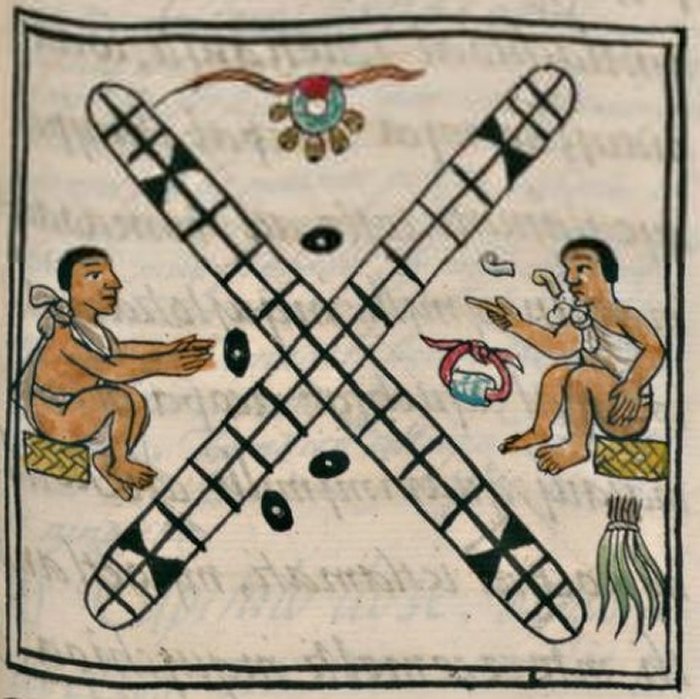
Patolli, as described in Bernardino de Sahagún’s “General History of the Things of New Spain,” was played by skilled individuals with their own game mats and pieces, carried in tied cloth bundles. Credit: Biblioteca Medicea Laurenziana Digital – Public Domain
Patolli is one of the oldest known games in America. It is characterized by its blend of strategy and luck and enjoyed by commoners and nobles. This game and its variants were prevalent among diverse pre-Columbian Mesoamerican cultures. It was played by the Teotihuacanos, Toltecs, inhabitants of Chichen Itza, Aztecs, Zapotecs, Mixtecs, and ancient Mayans.
The nine patollis, consisting of lines engraved on the floor resembling game boards, were discovered on the free road to Chetumal within a structure designated as T7-44279, near the town of Xpujil in Campeche. These board games are estimated to be over 1,000 years old.

Documentary sources indicate that patolli was related to deities, offerings, religious rites, and calendrical events. Photo: Felix Camacho Zamora.
Section 7 of the Mayan Train spans 287 kilometers between Quintana Roo and Campeche. The restorer noted that the nine patollis rested on a stucco surface measuring 11.3 meters in length by 2.8 meters in width and were found in poor condition.
The term “patolli” derives from the Nahuatl word meaning beans and is associated with deities, offerings, religious rites, and calendrical events, according to documentary sources. This Mesoamerican game involved lines engraved on the ground serving as game boards with beans used as dice. The patollis held recreational value and significant ritual importance within Mesoamerican cultures.

The INAH preserves nine patollis, Mesoamerican games, discovered during the construction of the Mayan Train. Photo: Felix Camacho Zamora.
The engravings exhibited substantial damage, including cracks, fractures, layer loss, disintegration, and abrasion, necessitating immediate conservation efforts.
Felix Camacho Zamora, coordinator of the Conservation Area of the Archaeological Rescue Project of the Mayan Train, explained that most engravings showed physical-chemical deterioration, including fractures, disintegration, abrasion, and material loss.

The ancient board games were very popular. Photo: Felix Camacho Zamora.
Emergency measures included lime water injections to restore cohesion and perimeter fillers. Work began on August 23rd. Each artifact was graphically and photographically documented before extraction. The process involved sealing and repairing fissures, cracks, and loss areas. Finally, a protective layer was applied before packing for transport to the Restoration Laboratory in Chetumal.
“The graphic record revealed various styles of patollis including two circular four square others diffuse lines precluding identification,” he added.

The engravings are currently being cared for and sheltered in a laboratory in Chetumal. Photo: Felix Camacho Zamora.
In a press release, Fernando Alemán Toscano, head of the Restoration Laboratory for Section 3 of the Maya Train in Mérida, stated that these findings highlight past societies’ cultural and spiritual intricacies. The presence of games in civic spaces suggests their use by high-ranking individuals for recreation or political mediation. Experts documented various patolli styles: two circular, four square, and others with diffuse lines complicating identification. This diversity reflects different construction phases and potential uses.
See also: More Archaeology News
Archaeologist Alfredo Saucedo Zavala noted that the ceremonial complex had at least two construction stages. These patollis are estimated to date back to the Late Classic period (600-900 AD), pending ceramic analysis confirmation. The recovered patollis are preserved in a Chetumal laboratory and are undergoing stabilization to ensure long-term conservation until their final destination is determined.
Written by Jan Bartek – AncientPages.com Staff Writer