

Conny Waters – AncientPages.com – During the Middle Ages, a devastating plague known as the Black Death killed about one-third of Europe’s population. The disease was caused by the bacterium Yersinia pestis, which fleas transmitted from infected rats to humans.
However, an earlier strain of Y. pestis appeared around 5,000 years ago during the Bronze Age and persisted across Eurasia for 2,000 years before disappearing. Unlike its medieval counterpart, this ancient strain could not be spread by fleas, leaving scientists puzzled about how it managed to circulate so widely.

Ancient DNA From A Domesticated Sheep Found At Arkaim
Recently, an international team of researchers—including University of Arkansas archaeologist Taylor Hermes—made a significant discovery that sheds light on this mystery. They identified DNA from Y. pestis in a 4,000-year-old domesticated sheep found at Arkaim, a fortified settlement in the Southern Ural Mountains near today’s Russia-Kazakhstan border. This is the first evidence of Bronze Age plague infection in a non-human host and suggests that animals like sheep may have played a role in spreading the disease across large regions.
The findings are detailed in an article titled “Bronze Age Yersinia pestis genome from sheep sheds light on hosts and evolution of a prehistoric plague lineage,” published in Cell by researchers from Harvard University and leading institutions in Germany, Russia, and South Korea.
Hermes is a co-director of an extensive, ongoing study focused on ancient livestock DNA. By examining the genetic material in animal bones and teeth, Hermes and his team can track the movement of domesticated cattle, goats, and sheep from their origins in the Fertile Crescent across Eurasia. This research sheds light on how these animals contributed to the development of nomadic societies and empires throughout history.

Graphical abstract. Credit: Cell (2025). DOI: 10.1016/j.cell.2025.07.029
“When we test livestock DNA in ancient samples, we get a complex genetic soup of contamination,” Hermes said. “This is a large barrier to getting a strong signal for the animal, but it also gives us an opportunity to look for pathogens that infected herds and their handlers.”
The research process is both highly technical and time-consuming. One of the primary challenges involves separating the host’s DNA from all other genetic material present in a sample. DNA from organisms that once lived in the soil where bones and teeth were buried can contaminate these samples, as can DNA introduced by researchers through saliva or skin cells during handling. Additionally, the DNA fragments recovered are often extremely short—typically around 50 base pairs—whereas a complete human DNA strand consists of more than 3 billion base pairs.
Arkaim And The Link To The Sintashta Culture
Animal remains pose further difficulties because they are rarely preserved as well as human remains, which are usually carefully buried. Animal bones may be exposed to heat from cooking or left in refuse piles, leading to greater degradation of genetic material due to environmental exposure.
During their analysis of livestock samples excavated at Arkaim in the 1980s and 1990s, Hermes and his colleagues discovered that a sheep bone contained traces of Yersinia pestis DNA.
The Next Question To Answer
Scientists have found numerous examples of identical strains of Bronze Age plague in humans thousands of kilometers apart. How did the disease spread so widely?
“It had to be more than people moving. Our plague sheep gave us a breakthrough. We now see it as a dynamic between people, livestock and some still unidentified ‘natural reservoir’ for it, which could be rodents on the grasslands of the Eurasian steppe or migratory birds,” Hermes said.
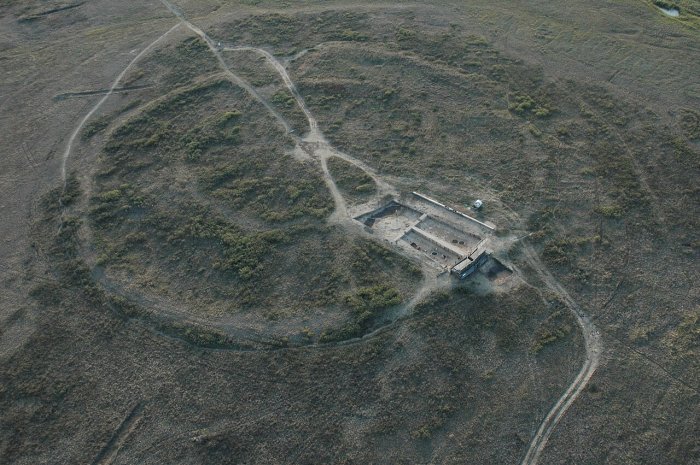
Aerial view of the archaeological site of Arkaim, in the steppe of the Southern Ural. Credit: Rafikova m – CC BY-SA 4.0
A natural reservoir refers to an animal that harbors bacteria without exhibiting symptoms of illness. Historically, during the Middle Ages, rats served as the reservoir for Yersinia pestis, while fleas acted as the vector transmitting the bacteria. In modern times, bats are recognized as natural reservoirs for pathogens such as Ebola and Marburg viruses.
Continuing research in this field, Hermes plans to collect human and animal samples in the Southern Urals near Arkaim to identify additional cases of Y. pestis infection. This investigation is particularly relevant to the Bronze Age, a period marked by significant changes in Sintashta culture, including the management of larger livestock herds and the adoption of horseback riding. Increased interaction with animals and expansion into new territories likely contributed to outbreaks of plague during this era.
See also: More Archaeology News
Hermes emphasizes that these ancient events offer valuable insights for today’s world. As humans expand into natural habitats for economic development, there is a risk of disrupting ecosystems and triggering dangerous consequences. It is important to recognize the interconnectedness of these environments and to strive to maintain ecological balance whenever possible.
“It’s important to have a greater respect for the forces of nature,” he said.
The study was published in the journal Cell
Written by Conny Waters – AncientPages.com Staff Writer