

Jan Bartek – AncientPages.com – A recent study has provided new insights into the initial settlement of New Guinea and Australia by modern humans, Homo sapiens, enhancing our understanding of early seafaring and maritime mobility. During the last Ice Age, lower sea levels meant that New Guinea and Australia formed a single landmass known as Sahul. While it is well established that Homo sapiens originated in Africa, questions persist about when and how people first reached Sahul.
This research is the result of collaboration between the University of Huddersfield’s Archaeogenetics Research Group and the University of Southampton’s Center for Maritime Archaeology. Their findings shed light on who these early settlers were, where they came from, and when this significant migration occurred.
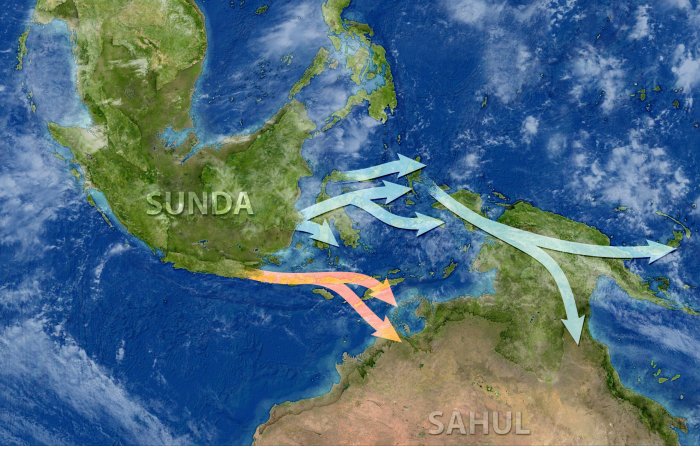
A map showing the migration of the first settlers to Sahul 60,000 years ago. Credit: Helen Farr and Erich Fisher
Evidence indicates that the ancestors of present-day New Guineans and Aboriginal Australians have lived in Sahul for tens of thousands of years. Many Aboriginal Australians maintain a deep-rooted connection to their land, believing they have always been there. However, scientific debates continue over the timing and routes involved in these ancient migrations.
Two main theories exist regarding when humans first settled Sahul: The “long chronology” proposes an arrival around 60,000 years ago (60 ka), while the “short chronology” suggests a more recent settlement between 45–50 thousand years ago (ka). This ongoing research clarifies these timelines as scientists work to understand humanity’s earliest maritime journeys better.
The interdisciplinary team, including colleagues at the University of Minho in Portugal, La Trobe University in Australia, and the University of Oxford, first focused on human mitochondrial DNA (mtDNA) genomes to address this question. The mtDNA is found in the mitochondria, the “battery packs” of our cells, which are found outside the cell’s nucleus, where the rest of our DNA is packaged. As a result, it is inherited only from our mothers, and the way the mtDNA sequences vary from one person to the next can therefore be used to recreate the maternal genealogy in incredible detail.
Genetic Analysis And Migration Routes
The research team examined nearly 2,500 mitochondrial DNA (mtDNA) genomes from Aboriginal Australians, New Guineans, and individuals from the western Pacific and Southeast Asia. By analyzing these genomes, they constructed a genealogical tree to observe how genetic lineages were distributed across different populations. Since DNA changes gradually over time, the researchers utilized the rate of these changes—referred to as the “molecular clock”—to estimate when specific lineages emerged in each region.
To ensure the accuracy of their molecular clock, they compared its results with colonization dates for islands in the Remote Pacific that are already well established. This comparison drew on findings from a recent Scientific Reports paper by an interdisciplinary team, including Professors Richards and Farr, led by Dr. Pedro Soares of the University of Minho.
Their analysis supports that modern humans (Homo sapiens) evolved in Africa and that there was only one major successful migration out of Africa. The team dated this migration to approximately 70,000 years ago using mtDNA evidence. Furthermore, they discovered that some of the oldest genetic lineages found exclusively among Aboriginal Australians and New Guineans date back about 60,000 years. These findings strongly support a long chronology for human settlement in these regions.
Research indicates that the most ancient human lineages can be traced back to Southeast Asia. The study found that while most of these lineages originated from northern parts of Southeast Asia, such as northern Indonesia and the Philippines, a significant portion came from southern regions, including southern Indonesia, Malaysia, and Indochina. This evidence points to at least two separate migration routes into Sahul—the ancient landmass comprising Australia and New Guinea. Notably, lineages from the northern route dispersed widely across both New Guinea and Australia, whereas those from the southern route were confined to Australia. Despite their different paths, both groups appear to have arrived around the same time.
To strengthen their findings, researchers compared mitochondrial DNA results with Y-chromosome data (inherited through male lines), genome-wide data (inherited through both parental lines), as well as archaeological and environmental evidence.
It is important to note that these conclusions are based on analyses of modern mitochondrial DNA by tracing genetic variation backward in time. While ancient DNA (aDNA) offers more direct insights into human history, it is rarely preserved in tropical environments. However, with help from Harvard’s aDNA lab, the team managed to extract DNA from an Iron Age archaeological sample in Indonesia. This sample suggested later “reverse” migrations westward into Indonesia from New Guinea but was too recent to inform about initial settlement events.
The significance of this research lies in its alignment with archaeological and paleoenvironmental records at a time when some geneticists have argued for a much shorter timeline for human dispersal out of Africa—based on newer dating methods related to Neanderthal ancestry among non-African populations. These methods suggest interbreeding occurred less than 50,000 years ago; if accurate, this would mean all non-Africans—including Aboriginal Australians and New Guineans—arrived after this event.
However, archaeological evidence shows modern humans were present in Southeast Asia and Australia at least 60,000 years ago. Supporters of a short chronology must therefore argue that earlier populations were replaced by later arrivals.
In contrast, this new research supports the view that today’s Aboriginal Australians and New Guineans are direct descendants of those first settlers who arrived around 60,000 years ago.
Professor Richards said, “We feel that this is strong support for the long chronology. Still, estimates based on the molecular clock can always be challenged, and the mitochondrial DNA is only one line of descent. We are currently analyzing hundreds of whole human genome sequences—3 billion bases each, compared to 16,000—to test our results against the many thousands of other lines of descent throughout the human genome.
See also: More Archaeology News
“In the future, there will be further archaeological discoveries, and we can also hope that ancient DNA might be recovered from key remains, so we can more directly test these models and distinguish between them.”
Professor Farr added, “This is a great story that helps refine our understanding of human origins, maritime mobility and early seafaring narratives. It reflects the really deep heritage that Indigenous communities have in this region and the skills and technology of these early voyagers.”
The study was published in the journal Science Advances
Written by Jan Bartek – AncientPages.com Staff Writer