

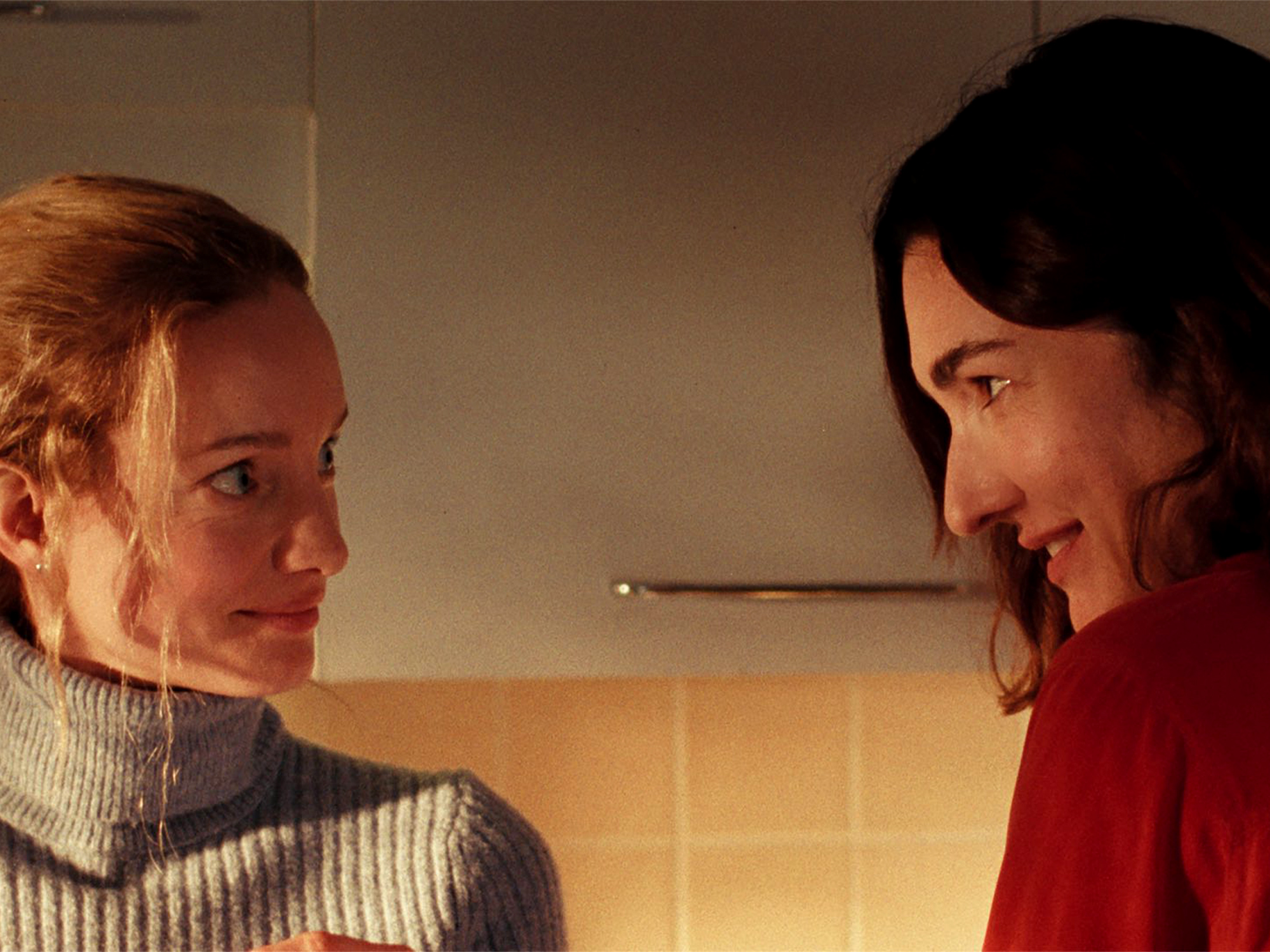
Not many sexual awakenings begin with the cawing of a crow. But in director Chloé Robichaud’s Two Women, the cries of this portentous bird trigger a shift that forces two suburban women to re-evaluate their lives and discover their true desires. When Violette (Laurence Leboeuf) hears the incessant bird sounds at night, she is convinced that it is her neighbours Florence (Karine Gonthier-Hyndman) and David (Mani Soleymanlou) in the throes of pleasure. She confronts Florence about the noise, who subsequently admits that she and her partner haven’t had sex for years. The two women bond over their frustration with domestic life as wives and mothers; David is completely uninterested in Florence physically, while Violette’s husband Benoit (Félix Moati) is constantly away at work conferences (sleeping with his coworker).
Two Women is a remake of a 1970 film of the same name from filmmaker Claude Fournier, which at its time was one of the most commercially successful films in the history of Québécois cinema and incredibly provocative for its time. Robichaud brings the subtle sexuality of the original to the forefront of her film, which is heavy on the female gaze; lingering shots of men’s shoulders, necks and biceps reflect Florence’s march towards sexual emancipation. Sex scenes – of which there are plenty – are beautifully shot, framed and lit to reflect the magic of their liberating nature, while the crow’s squawks are replaced by the women’s guttural cries of pleasure.
Get more Little White Lies
The screenplay from writer Catherine Léger is dryly funny, firmly rooting Fournier’s classic in the 21st century with references to Zoom meetings, debates about the #MeToo movement and modern outlooks on monogamy as a societal construct. Florence and Violette are consistently framed indoors, confined to bedrooms and kitchens or trapped behind windows, gazing out longingly at the world outside which only their husbands seem to be able to enter into.
But over the course of the film the two women rewrite the rules of this domestic space, liberating themselves and dismantling the structures from within. They break things just to call over handymen, whom they then seduce and sleep with while their husbands are away. The strongest moments of comedy are when the two women reunite to talk about their sexcapades, using metaphors like, “I had my cable installed,” and, “We got deep into the source of the problem. My source.”
The film shines brightest in the quiet moments of contemplation that each woman experiences. Leboeuf’s Violette is a sweet and passive new mother who is emboldened by the actions of her new friend. Gonthier-Hyndman lets loose as the wild and nihilistic Florence who, as she comes off her antidepressants, abandons all propriety and embraces her animal instincts, from dancing naked in the window to cutting her wrist with a broken beer bottle to prove that it’s harder to die in life than in the movies.
While neither director nor screenwriter seem to have anything more substantial to say about female pleasure beyond the fact that it’s important, you do nevertheless find yourself cheering for Florence and Violette when they embrace their selfish side. The film unpacks the idea of the family unit, expressing how women can (and should) be able to balance motherhood and wifedom with their most basic human desires. And it’s all thanks to a crow.