

Jan Bartek – AncientPages.com – In a quiet field in Quadring, UK, a small yet magnificent artifact lay patiently beneath the earth, waiting for the moment it would be discovered—and now, at last, it has been found.
Polish history enthusiast Rafał Wesołowski, from Boston, discovered a medieval silver ring engraved with sixteen mysterious runic symbols while searching in the South Holland region- What might have seemed like an ordinary day became a moment that connected the present with the distant past.
Credit: Portable Antiquities Scheme
Rafał did more than just make a remarkable find. He chose to share it with the world by reporting it to the Portable Antiquities Scheme (PAS), a database that gathers privately found archaeological objects. Thanks to contributions like his, PAS is helping researchers build a richer, more detailed picture of our shared human story.
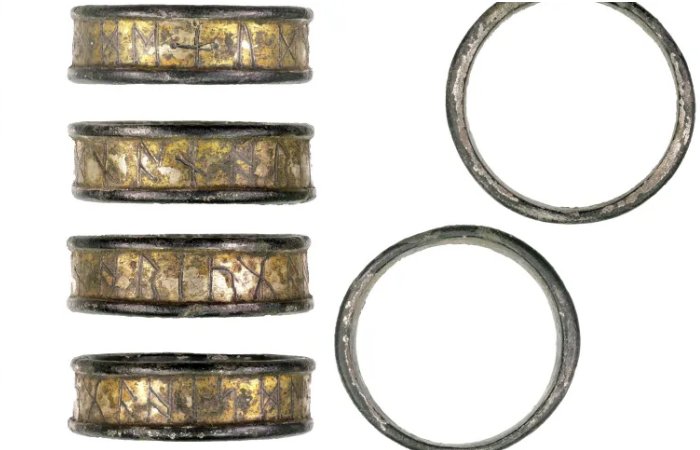
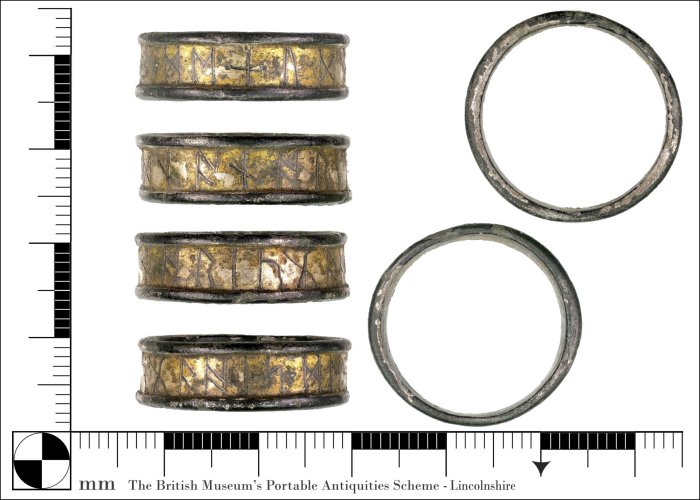
The ring itself is small but beautiful. It is a silver-gilded finger ring dating to the 8th to 10th centuries (around 700–1000 AD). Just over 23 mm in diameter and 7 mm wide, it carries 16 runic symbols along its outer surface, running from left to right. Their full meaning is still unknown.
Experts Dr. Martin Findell and Jasmin Higgs of the University of Nottinghamshire have identified the ring as part of a very small and rare group of early medieval rings with runic inscriptions. It now stands alongside other extraordinary finds, such as the Kingmoor ring—possibly used as a magical or protective amulet—and the Wheatley Hill ring, preserved in the British Museum.

Credit: Rafał Wesołowski
The Quadring specimen is adorned with a beautifully executed series of sixteen runic characters, each carefully engraved in fine, mostly straight lines that end in delicate dots, likely created with a center punch. These subtle dotted details are especially noteworthy, as they closely resemble those seen on other runic rings, such as the example from Wheatley Hill, highlighting the craftsmanship and shared traditions of the period.
The interior of the ring remains unmarked, showing no trace of inscription or deliberate modification, which further draws attention to the care invested in the outer design. Alongside the runes, a thoughtfully placed cross indicates the beginning of the text, and a distinct symbol serves as a separator or punctuation mark. As described by researchers from the University of Nottinghamshire, these features together reflect a remarkable level of intention, skill, and cultural significance in the creation of this artifact.
Recalling the discovery, he said to the BBC: “You always dream of finding something amazing, but you never truly expect it to happen.
“I remember standing there in the field, holding it in my hand, thinking ‘how is it possible that I am the first person to touch this again after more than a thousand years’?”
Credit: Portable Antiquities Scheme
“For me, the idea that someone over a thousand years ago might have worn this ring, not just as jewelry, but as something meaningful or protective, is incredible.”
“The full meaning of the runes is still a mystery, but specialists think they may include a personal name and the word ring,” Wesołowski said.
See also: More Archaeology News
Archaeologist Dr. Lisa Brundle, a Portable Antiquities Scheme (PAS) finds officer at Lincolnshire County Council, told the BBC that additional objects discovered at the same location by Wesolowski—such as a late Anglo-Saxon buckle—may indicate the presence of a previously unknown early medieval archaeological site in the area.
According to Dr. Brundle, taken together, these finds suggest a community of significant status and may even point to the existence of a literate elite. She added that the artifact, which has been officially designated as a treasure by Lincolnshire, may eventually be housed at the Lincoln Museum, where it could help deepen and refine our understanding of the early medieval period.
Written by Jan Bartek – AncientPages.com Staff Writer