

Conny Waters – AncientPages.com – Constructed by the pre-Columbian Maya civilization between the 8th and 12th centuries CE, El Castillo is far more than an ancient structure—it is compelling evidence of the Maya’s extraordinary architectural, religious, and astronomical sophistication.
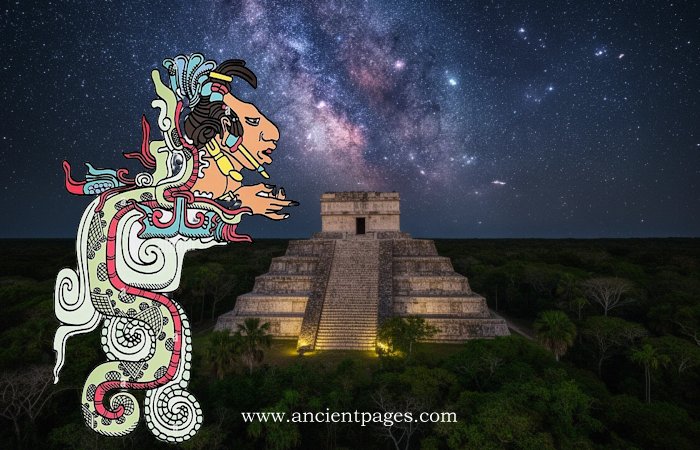
It served as a temple dedicated to Kukulcán, the Feathered Serpent deity of the Yucatec Maya, who is closely related to Quetzalcoatl, revered by the Aztecs and other Central Mexican cultures.
El Castillo, or the Temple of Kukulcán, dominates the center of Chichen Itza in Yucatán, Mexico.
One of the most persuasive reasons to regard El Castillo as a masterpiece of archaeoastronomy is the famous hierophany known as the “descent of Kukulcán.” During this event, a serpent-shaped band of sunlight appears to glide along the northwest balustrade of the pyramid, ending with the dramatic illumination of the carved stone serpent head at its base. This is not a random play of light and shadow. It is a deliberate, awe-inspiring alignment that powerfully connects architecture, religion, and the sun’s movement.
Although this phenomenon was long believed to occur only on the equinoxes, recent research shows that it is even more sophisticated than previously thought. Detailed studies now indicate that the effect follows a specific, predictable pattern of solar illumination on the balustrade throughout the year. Four renowned archaeoastronomers have documented their observations and presented their findings in the respected journal Arqueología Mexicana (No. 197, March–April 2026).
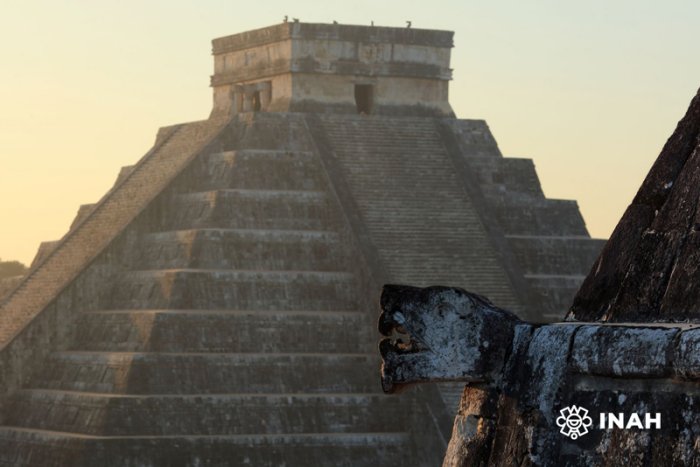
The last glimmers of light on the balustrade are briefly visible around October 29. Credit: Gerardo Peña, INAH.
In the article “El Castillo de Chichén Itzá. Evocación de un mensaje majestuoso de trascendencia calendárica,” Orlando Casares Contreras, from the INAH Yucatán Center; Arturo Montero García, from the University of Tepeyac; Jesús Galindo Trejo, from the Institute of Aesthetic Research at UNAM; and David Wood Cano, from the ENAH-UNAM Archaeoastronomy Seminar, report on several calendrical and astronomical aspects associated with this building, which can contribute to a better understanding of the hierophany that goes beyond the equinoctial days.
Luminous Triangles And Lights Over Chichen Itza
The pyramid, standing 30 meters tall, has nine tiers and a shrine at its summit. Each side measures 55.5 meters, and it features four staircases topped with balustrades or ramps. As the sun sets, it casts its shadow on the northwest ramp, creating triangular patches of light that form the shape of a serpent. The process begins from the ninth upper section, and as the sun descends toward the horizon, other luminous triangles appear on the lower part of the balustrade.
The first trace of light at the top of the ramp appears on February 12th; at that time, not all the triangles have formed, and the light does not persist until sunset, lasting only a few minutes. As the days pass, the triangles appear in varying numbers, but they disappear before sunset. On the afternoon of March 4th, five triangles form.
In the following days, six triangles appear. By March 15th, seven triangles of light are projected, and they remain visible until sunset on March 25th; this final period includes the spring equinox.
The most interesting aspect is that the archaeoastronomical phenomenon, in which day and night are of equal length, occurs midway through this period, five days before and five days after the spring equinox. Scientists believe that observing the seven triangles on the ramp may have helped pinpoint the equinox, since the eighth triangle appears around March 26th.
The nine triangles begin to form on April 9th. In the following days, their shape widens until May 24th, when the entire balustrade is fully illuminated: this is the date of the first zenith passage of the Sun over Chichen Itza. The illumination remains at its peak until June 21st, the summer solstice. The balustrade is fully illuminated for the last time on July 19th, when the second zenith occurs.
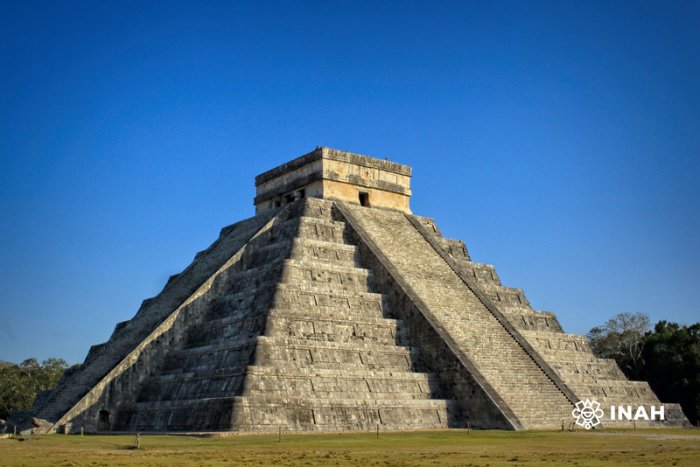
One of the events that has made El Castillo at Chichén Itzá popular is the hierophany known as the descent of Kukulcán. Credit: INAH.
Subsequently, the nine triangles gradually take shape again until September 2nd, when they reach their full form, one for each section of the pyramid. As the days pass, fewer triangles appear, and once again, the day of the autumn equinox is marked by a cycle in which seven triangles appear on the balustrade.
Then, day by day, the triangles gradually diminish until October 9th, when only five triangles remain, disappearing completely at sunset. Afterward, they vanish before sunset. The last glimmers of light on the balustrade are briefly visible around October 29th.
After that date, the ramp remains in shadow for 52 days before the winter solstice and for another 52 days after it, when the new lighting cycle begins on February 12th of the following year.
Advanced Astronomical Knowledge Of The Ancient Maya
The monitoring of the lighting pattern throughout the year by Mayan priest-observers may have served not only to locate the equinox and indicate the arrival of the calendrical-astronomical dates that, for three millennia, were used to orient the main architectural structures in Mesoamerica, but also to guide agricultural activities, the researchers point out.
See also: More Archaeology News
They conclude that a characteristic aspect of El Castillo relates to the importance of time measurement in the Mesoamerican calendar system. The Maya used their astronomical knowledge, encoded in their calendar counts, to achieve admirable precision in measuring time, even though some scholars have doubted that Mesoamerican observers identified the equinox.
Source: INAH
Written by Conny Waters – AncientPages.com Staff Writer