

Jan Bartek – AncientPages.com – A hiker has made a rare discovery during a morning walk in the Austrått district of Sandnes, Norway.
The hiker describes himself as naturally curious, eager to explore the local area, and interested in understanding his surroundings.
He lives in Austrått, near the popular hiking area of Riaren. He observed a fallen tree from a storm several years ago and became interested in what lay beneath it.
“I saw a mound beneath the tree and poked it with a stick. Suddenly, something glittered. I didn’t quite understand what I had found,” the hiker says.
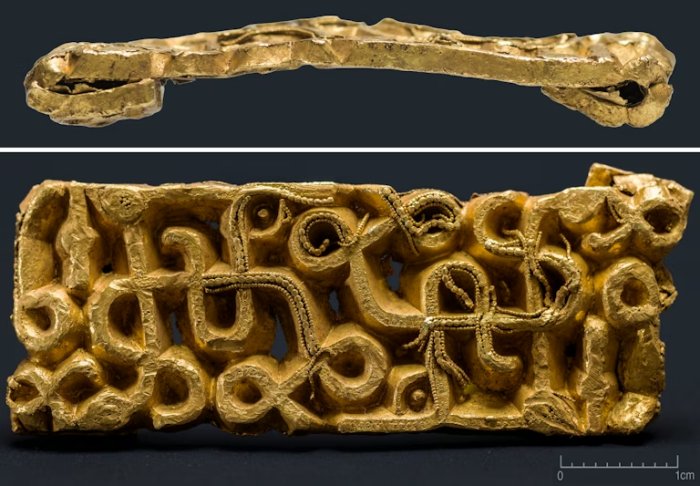
A hiker discovered this richly decorated gold sword scabbard, about 1,500 years old and likely belonging to a chieftain from Hove. Photo: Annette Græsli Øvrelid, Archaeological Museum, University of Stavanger
The find was a 1,500-year-old, richly decorated gold sword scabbard fitting, which probably belonged to a chieftain who ruled at Hove.
Archaeologist and associate professor Håkon Reiersen at the University of Stavanger’s Archaeological Museum describes the find as magnificent.
“You are completely taken aback when such discoveries occur. The odds of finding something like this are minimal,” says Reiersen.
The Gold Treasure May Have Belonged To A Chieftain
The gold dates to the 6th century, during the migration period in Norway. Richly decorated, it once adorned a scabbard attached to a belt. This is the first such discovery in Rogaland, with only 17 similar finds reported in Northern Europe.
The individual who wore this sword was likely a local leader in the early 6th century, commanding a group of loyal warriors. While gold scabbard fittings typically show little wear, this example is well-used, suggesting the chieftain used it frequently. Its presence highlighted his status and authority, according to Reiersen.
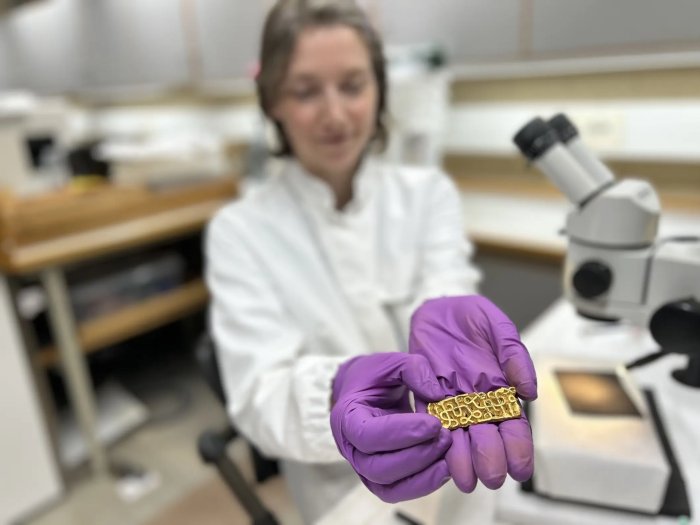
Researcher and conservator Hege Hollund at the Museum of Archaeology at the University of Stavanger presents the gold find. (Photo: Terje Tveit / Museum of Archaeology / University of Stavanger)
The scabbard measures six centimeters wide, a few centimeters high, and only a few millimeters thick. It belonged to an exceptional sword reserved for the most powerful individuals of the era.
Siv Kristoffersen, retired professor at the Museum of Archaeology, explains that the fitting features filigree ornamentation – goldsmith work made from thin metal threads bent or twisted into patterns.
“This places the object among the finest works from the period, created by highly skilled goldsmiths,” Kristoffersen says.
Human Head With An Animal Body
But what does the intricate motif on the fitting represent? According to Kristoffersen, it is meant to depict animals.
“When trying to identify these strange creatures, it’s always helpful to look for the eye first. Then a nose and facial profile quickly emerge,” she says.
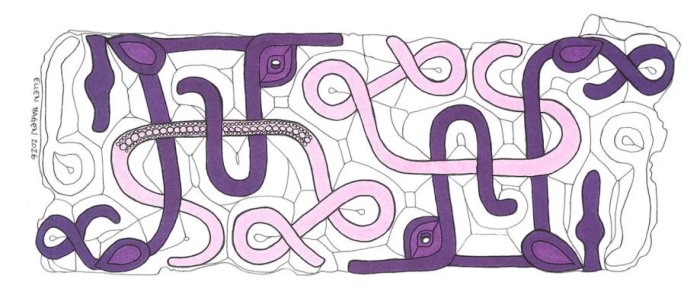
Drawing of the decoration in the main panel on the fitting from Austrått. The animal figure is shown in violet, while the intertwined band is coloured pink. (Image: Ellen Hagen / Museum of Archaeology / University of Stavanger)
The motif is symmetrically composed of two animal heads in profile facing each other – one positioned along the upper edge and the other inverted along the lower edge.
“It’s possible that this should be interpreted as a human head with an animal body – a hybrid motif frequently found in this type of ornamentation,” Kristoffersen says.
Buried In A Rock Crevice As A Sacrificial Offering
Two additional significant sacrificial finds have been made in the marshes below the Riaren. The first, a silver necklace with gold decoration, was discovered during 19th-century plowing. The second, an unusually large Roman bronze cauldron produced on the Rhine around 300 AD, was found in 1907 on the neighboring Høyland farm.
The gold found at Austrått was buried in a rock crevice, likely as a religious offering to the gods in the 6th century.
In 536, Norway and the Nordic region may have experienced a catastrophic event following a major volcanic eruption in Central America. The event is known as the Fimbulwinter.
The eruption likely caused several years of severe cooling, as described by multiple European sources. Temperatures across the Northern Hemisphere may have dropped by several degrees, resulting in short, cold summers. Repeated harvest failures followed, and up to half the population may have perished.
During this period of famine and crisis, large quantities of gold were sacrificed to the gods in hopes of improved conditions. According to Reiersen, by sacrificing such remarkable items, the leaders at Hove affirmed their status and power.
A Concentration Of Power In Jæren
About 1,500 years ago, researchers think that Jæren in Rogaland was home to many influential people. Political, military, and religious power were all centered in a small area.
Archaeologist Håkon Reiersen says that nowhere else in Norway has as many power centers as Jæren.
See also: More Archaeology News
Jæren features large burial mounds, remnants of substantial longhouses, and hillforts.
Residents benefited from fertile farmland and controlled significant coastal routes known as Nordvegr, as well as major trade in furs and iron.
Museum Exhibition
Museum Director and Professor of Archaeology Kristin Armstrong-Oma expresses her appreciation for the addition of the gold find to the museum’s collection.
“We extend our sincere gratitude to the attentive hiker who contributed a valuable piece to our understanding of the power center at Hove during the Migration Period. The museum’s team includes leading researchers in this field, enabling us to study the find and its ornamentation further and to gain new insights into the power elite of that era”, says Armstrong-Oma.
She adds that the find will be exhibited and available for public viewing at the Archaeological Museum at the University of Stavanger as soon as possible.
Source: University of Stavanger, Science in Norway
Written by Jan Bartek – AncientPages.com Staff Writer