

Conny Waters – AncientPages.com – Scientists are investigating a puzzling cooling event that occurred 13,000 years ago, when the last Ice Age was coming to an end. The thick ice sheet covering the Northern Hemisphere was beginning to melt, and the climate was warming.
However, the northern regions then experienced rapid climate change. Within a decade or less, temperatures dropped dramatically around 13,000 years ago.
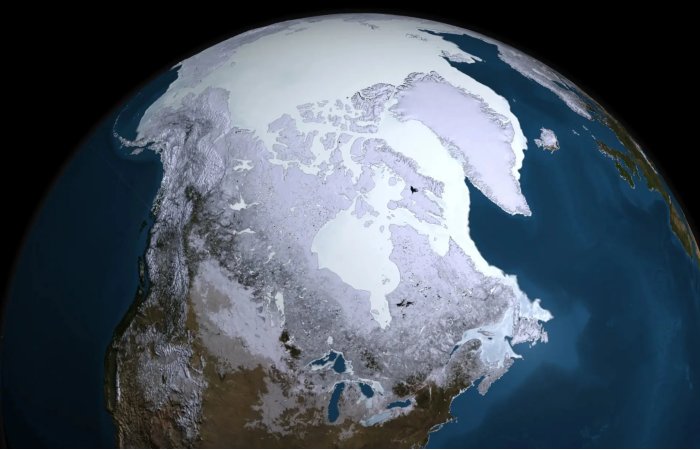
Illustration of a large ice sheet over Greenland and North America. Credit: NASA
Jostein Bakke, professor at the University of Bergen’s Department of Earth Science, describes this as an abrupt reversal. The cause, however, remains uncertain.
Ripple Effects For 1,000 Years
This cold period lasted for a thousand years. Ice sheets in North America and Scandinavia expanded, and ocean currents transporting warm water from the Gulf of Mexico weakened.
This circulation, known as the AMOC, is frequently discussed in research for its potential to weaken today.
If AMOC weakens, northern regions could become significantly colder than they are today.
Researchers continue to investigate what triggered this cooling event 13,000 years ago. A recent study suggests that a sudden climate shock contributed to the Younger Dryas. The team reports evidence of extensive volcanic activity at several locations during this period.
“I don’t think it fully explains the Younger Dryas, but it could be part of the explanation. I think this looks like solid geological work,” Bakke told Science in Norway after reading the study.
Freshwater, Melting Ice, and Meteorites?
The reasons behind what happened are complex and debated, but a period of major volcanic eruptions that cooled the climate may have played a role.
Sediments found in caves in the United States reveal a detailed geological record spanning long periods, according to the study.
The researchers identified certain isotopes that may indicate increased volcanic activity at the onset of the Younger Dryas. They do not know where the eruptions occurred or how large they were.
But there may have been more volcanic eruptions than usual during a period of just over a hundred years at the beginning of this period.
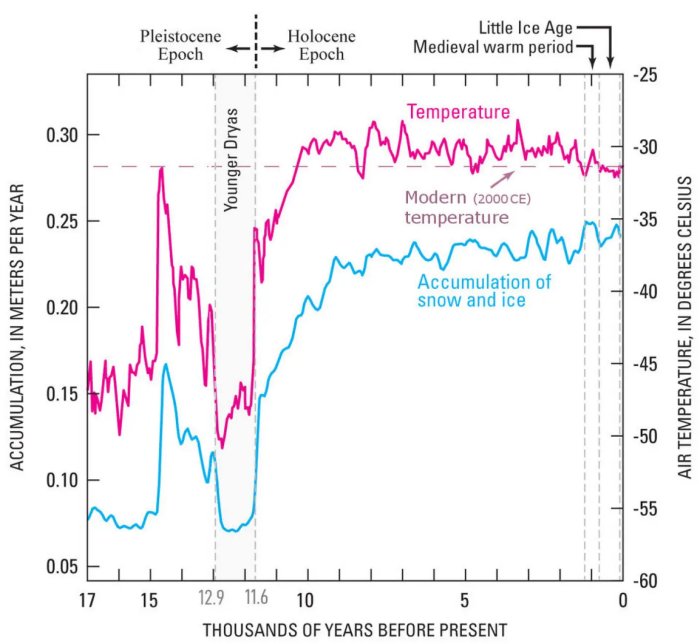
Here you can see how abrupt the estimated temperature change on the Greenland ice sheet was over the last 17,000 years. The Younger Dryas stands out dramatically. (Graph: USGS)
Jostein Bakke notes that the study includes many strong measurements and a detailed time series, making increased volcanic activity seem likely.
Large volcanic eruptions can lower temperatures and affect the climate by spewing particles and dust that block sunlight. This has previously had major consequences for life on Earth, including for humans, who may have experienced major societal collapses as a result of volcanic eruptions.
Sudden Rapid Change
The climate change occurred rapidly.
Professor Bakke states that ice cores from Greenland suggest the change may have occurred in less than a decade.
The abruptness of the change led to an earlier hypothesis that a major meteor impact caused the Younger Dryas and subsequently affected the climate.
“That hypothesis has been disproven,” he says.
Researchers cite scientific reviews that offer little evidence that a meteorite impact was a major cause of the event.
Bakke explains that large volumes of meltwater from inland regions, including North America, were instrumental in triggering this rapid cooling.
See also: More Archaeology News
He adds that when freshwater enters the North Atlantic, it can freeze, creating a layer above the warm water moving north from the Gulf of Mexico.
“That can weaken the exchange of heat between the ocean and the atmosphere. This happened on a very large scale during the Younger Dryas because so much meltwater flowed into the ocean,” he says.
Bakke believes increased volcanic activity during this period may help explain why the Younger Dryas was both unusually cold and abrupt.
Source: Science in Norway, Science Advances
Written by Conny Waters – AncientPages.com Staff Writer