

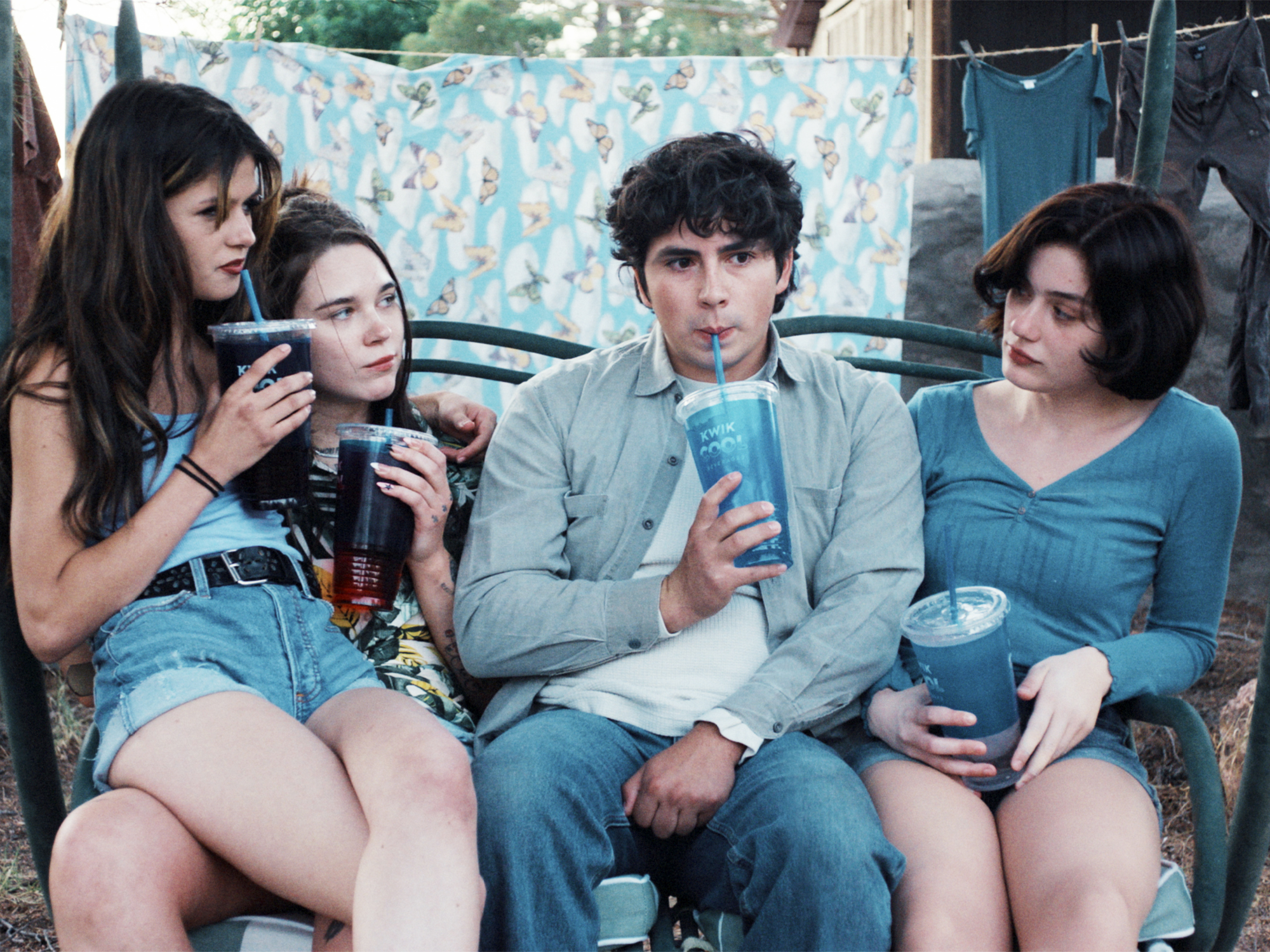
Rye bread cocooned in clingfilm and a jar of monstrous pickles are the gifts Brandenburg exchange student Franny bestows upon her host family as she arrives at the stagnant town of Las Cruces, New Mexico, in 2001. The items are as much a present as they are a reminder of the cultural differences between America and, well, pretty much anywhere else in the world. You quickly get the sense that Franny is a reticent teen, though less in the way of angst and more in a distinctly European manner. It feels almost prophetic that she will cast herself as an outsider at the high school where she’s set to spend the next formative year of her life, yet her nonchalant nature proves magnetic to her peers.
The same can’t be said for her relatively hostile host mother, Evelyn Garcia, who runs a tight ship that both her biological and foster daughters, Robin and Patty, instinctively know their new arrival will struggle to navigate. Nevertheless, Franny leans into the Americana of it all; drinking illegally in the desert, riding bikes down empty winding roads, and collecting poolside tan lines like military stripes. A few weeks into the trip, after an extended layover in New York before making her way down toward the border, she watches the unimaginable unfold live on television as a second plane strikes the Twin Towers.
Get more Little White Lies
As we know, this event reshapes the ideological landscape for many Americans, particularly around perceptions of “the other,” and ignites widespread debate over the correct course of action, revenge or justice. Somewhere in the midst of this, Franny gets caught in the crosshairs and is ousted from the Garcias’ home one evening after school. Though mildly disappointed, she has little trouble settling in with a new family, where she is given her own room and greater freedom.
It is here, roughly halfway through, that the film sheds its skin like the snakes native to the Chihuahuan Desert, which envelops the characters, only to settle into a largely formulaic coming-of-age tale riddled with clichés. With the introduction of local bad boy Elliot (David Flores), a star-crossed lovers arc takes the reins. This dynamic, shaped by Franny’s impending departure, is a setup that frustratingly holds so much potential, only to instead descend into a contrived and bloated exploration of mental health.
In their acting debut, Naomi Cosma commands a strong presence, but Katharina Rivilis’ script restricts them from showcasing the full emotional range you might expect of a teenager uprooted in a society thousands of miles from home. This year abroad, coinciding with a period of heightened divisiveness and animosity, is a circumstance that superficially shapes elements of the plot. However, the film never fosters its drama or tension, which dissipates almost instantaneously upon each emergence. It’s as if the film repeatedly finds its rhythm, only to slip back into complete stillness.
Under the starry night sky, just hours before Franny is homebound, one of the many pals she has made along the way confesses that their friendship has changed her life forever. This moment, intended as a neat conclusion, instead exposes I’ll Be Gone In June’s central flaw: they all remain much as they started, with only microscopic evolution visible to the naked eye. It leans heavily on aesthetics and fleeting teenage whimsy, but rarely probes the mark they’ve left on one another or the lessons imparted along the way, undercutting any sense of sentimental merit.