

Though The Birthday Party marks the first time Léa Mysius has directed a film in contention for the festival’s Palme d’Or, the French filmmaker is no stranger to Cannes. Her sophomore feature – an odd, beguiling Adèle Exarchopoulos-starrer called The Five Devils – was a highlight of the 2022 Director’s Fortnight selection, and she helped write Claire Denis’ Grand Prix-winning Stars at Noon, as well as Jacques Audiard’s reviled-and-revered crime thriller musical Emilia Pérez, which in 2024 took home both the Jury Prize and Best Actress award.
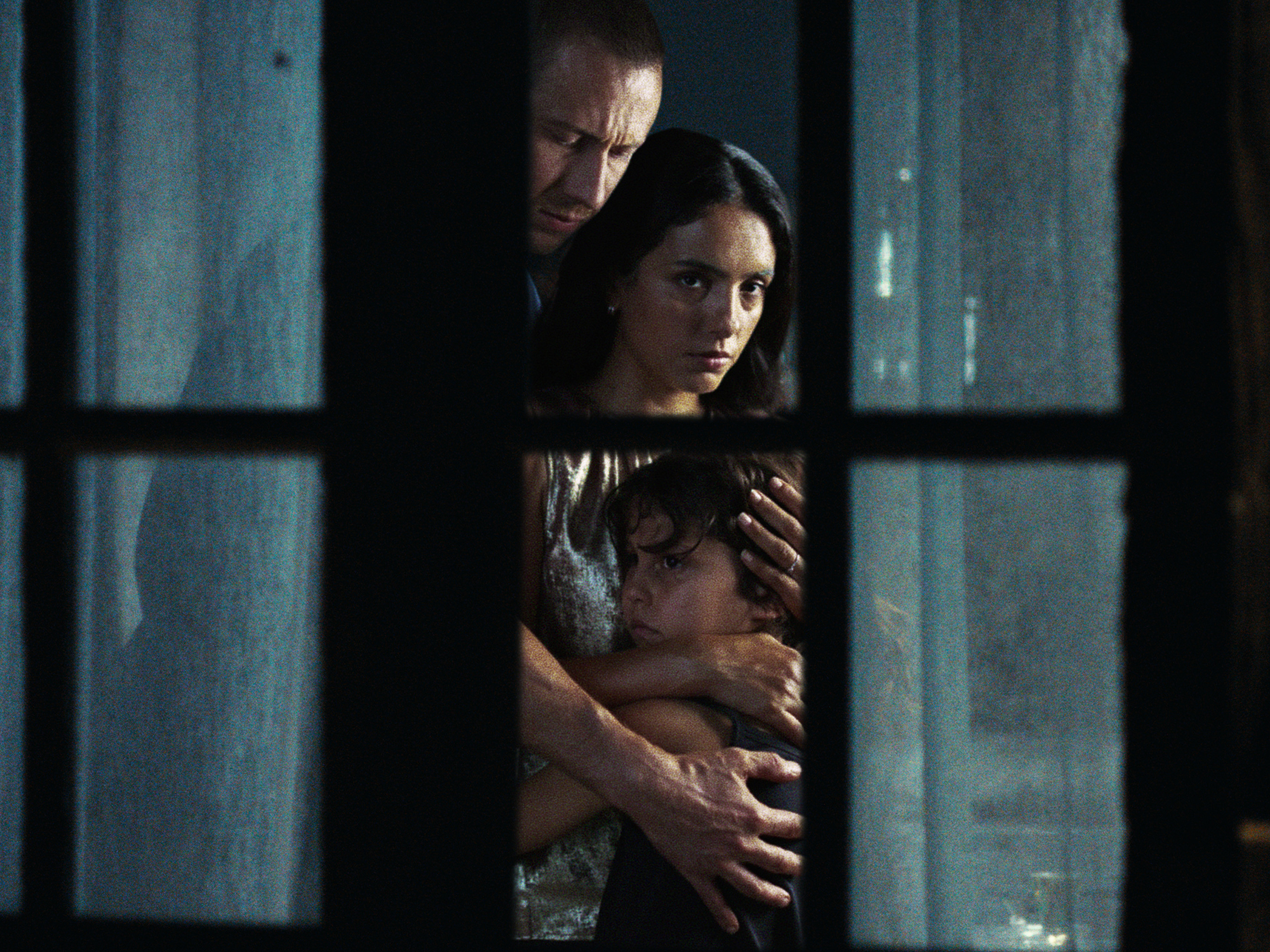
Low-lit and bluish, The Birthday Party is a slow-burn affair that allows Mysius’ penchant for high-contrast melodrama to shine through. Contained by its setting of a remote marshland, the film primarily takes place in two neighbouring households: the studio-home of an Italian abstract painter called Cristina (Monica Bellucci) and the farmstead of the Bergogne family, consisting of Thomas (Bastien Bouillon), Nora (Hafsia Herzi) and their young daughter Ida (Tawba El Gharchi).
Get more Little White Lies
In a narrative choice that encapsulates a kind of vertical video realism, the plot’s inciting catalyst is a TikTok posted by Ida: a short clip of her wearing sunglasses and dancing with her parents to the early whistle-inflected bars of A$AP Rocky’s ‘Praise The Lord’. Nora is furious when she finds out, and forces Ida to delete the video. This comes across as a bit of an overreaction until we learn why Nora is so protective of her family’s privacy – her chequered past as Leïla, an accomplice in a majorly shady trafficking ring. Nora’s loved ones are preparing a surprise party for her 37th birthday as the clip’s minor virality pulls a cadre of undesirable characters back into her life – the menacing Franck (Benoît Magimel) along with his henchmen Flo (Pal Hamy) and Stutt (Alane Delhaye) crash the celebration and The Birthday Party kicks into gear as a typical yet twistily effective home invasion thriller.
That Mysius’ film is one of several in this year’s lineup in which external forces push a patriarchal family into crisis – including James Grey’s Paper Tiger, Hirokazu Kore-eda’s Sheep In The Box and Cristian Mungiu’s Fjord – seems to reflect social anxieties around the future of the traditional nuclear unit. It also fits into an industry-wide trend of bottle movies that use only a small cast; a sign of the times for the beleaguered once-behemoth of cinema.
Like making a film, raising a child and maintaining a comfortable standard of living are increasingly unrealistic prospects in a misanthropic economy overrun with punishing salaries, nihilistic tech monopolies and rampant platform capitalism. While Thomas tends the cows and Ida does her homework, Nora is attempting to ascend the corporate ladder, working as part of a regional scheme introduced to support vulnerable rural areas. As her coworkers fire off confetti canons to congratulate Nora on a decade of employment – and being named head of their town’s planning hub – there is the unavoidable sense that this is still not enough, and further apprehensions and desperation lie ahead.
With disconcerting string music and dark-saturated frames of the farmland, The Birthday Party draws from horror tropes to sustain its intrigue: making a gore of the jellied strawberries atop Nora’s cake, and at one point CAD-rendering the two houses and their inhabitants in grey-toned static droplets. From visuals like these to Cristina’s expansive abstract paintings (for which the director enlisted the help of artist Corinne Mercadier) there’s a lot of craft to Mysius’ third feature, a well-paced adaptation of Laurent Mauvignier’s Histoires de la Nuit. It doesn’t quite manage to transcend that form of it, but The Birthday Party is enjoyable enough – timely, gory, gripping and just a little over-the-top.