

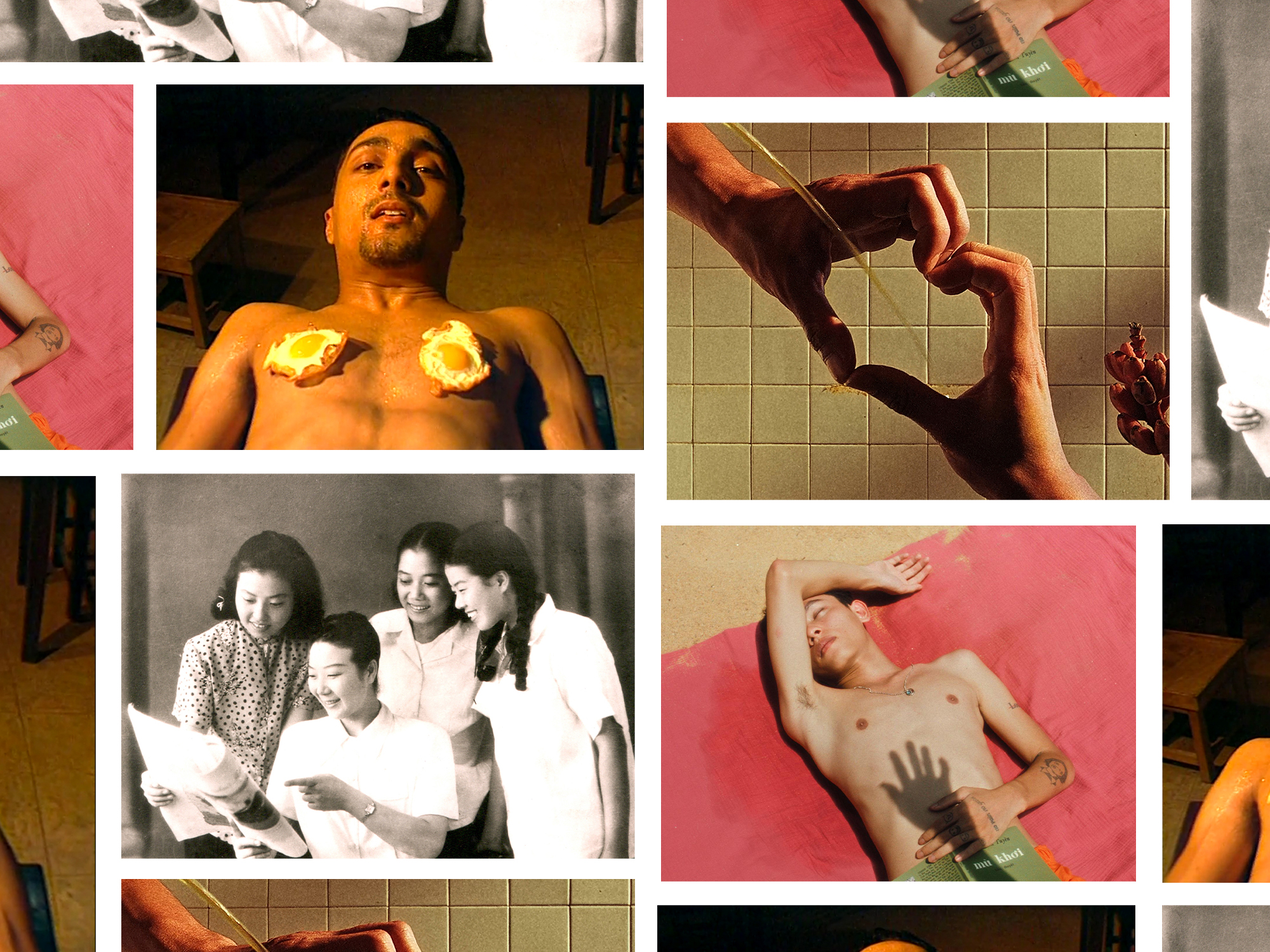
This is the first of three pieces published in collaboration with Queer East Film Festival, whose Emerging Critics project brought together six writers for a programme of mentorship throughout the festival.
Rebecca Liu
Recently, the Creative Industries Policy and Evidence Centre published a study that found the racial demographic with the lowest participation in cultural life in the UK is Asians. Perhaps this could be attributed to the UK’s immigration policies, which working professionals are granted entry into the country, and what their attitudes towards the arts are; perhaps this could be attributed to a worldwide recession that has exerted pressure on where people choose to spend money, on top of a domestic financial structure that has diverted government funding from the arts to STEM. Perhaps it could be any number of things outside the scope of this dispatch.
Whatever the reason may be, Asians‘ low rates of participation factor into the British Film Institute’s process of deciding where to distribute funding, with Queer East being one of the recipients. If nothing else, no one can accuse the UK government of not trying, at least, to maintain the appearance of supporting a diverse arts scene. But what does such pluralism mean in a cultural landscape where the relations of production are increasingly determined by one’s proximity to capital? Lowkenuinely, in the parlance of terminally-online Gen‑Z, it’s a bad time to be young, a person of color, and queer/trans, and God forbid… a mix of all three.
I say this not to be a doomer, but because of the current cultural climate. It’s been notoriously difficult to get a job, racism is on the rise, and the homies still cannot get state-funded t‑dicks! These material conditions have not changed, no matter how many Asians we have seen on the screen this past year. Not that Asians on screen have fared any better in these circumstances. For creatives too, the past few years have made it hard to scrape together external funding for left-field projects that don’t slot neatly into the bottom-line of production budgets funded by the likes of Netflix or other privately-owned companies, with governments offering little support. Downstream of this, the media that comes out of this financial structure reflects this narrowing of financial honeypots – not much diversity, lots of iterative slop.
The curation of films at this year’s Queer East Film Festival responds well to this financial and cultural conservatism with a heaping serving of faggotry and other perverse pleasures. Arguably, part of the scope of queer art is to de-aestheticise and question heteronormative relations that produce capital accumulation. DIY filmmaking functions as one such method of destabilisation in Tender Guerrillas: Self-Filming and Queer Becomings, curated by Najrin Islam. Through their improvisational camera work, the films present an array of idiosyncratic visual languages that affirm the multiplicity of what queerness, what South Asian-ness can look like. Without flattening such subjectivities into an essentialist identity, we see the plurality of what family can be, what productivity can be, what a good life can be. In particular, Riyad Vinci Wadia’s insistence on transgressing social codes in BOMgAY culminates in a memorable library hook-up scene, in which gleaming sculpted men fuck and get fucked among the stacks of books. The DIY animation of Tejal Shah’s There’s a Spider Living Between Us renders illicit desire legible, animating through paper cutouts what otherwise is difficult to vocalise out loud: thoughts about sex, thoughts about our parents having sex, what female desire looks like for us versus our mothers. In Summer in My Veins, Nishit Saran goes back and forth between telling his mother that he is gay and keeping it an undisclosed secret. His self-reflexive camera oscillates between himself and his mother, dissolving the boundaries of subject and object, director and directed. One is not simply queer or South Asian, but becomes queer and South Asian.