

Jan Bartek – AncientPages.com – After months of examination, two University of Colorado Boulder scholars deciphered significant new fragments of works by Greek tragedian Euripides.
In November 2022, Basem Gehad, an archaeologist with the Egyptian Ministry of Tourism and Antiquities, sent a papyrus found at the ancient site of Philadelphia in Egypt to Yvona Trnka-Amrhein, an assistant professor of classics. They also uncovered the upper half of a Pharaoh Ramesses II statue during their excavation at Hermopolis Magna.
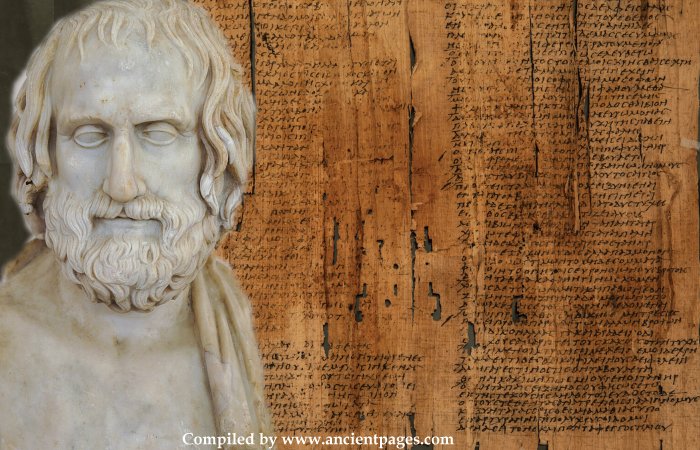
Left: Bust of Euripides. Credit: NikonZ7II – CC BY-SA 4.0 – Right: The Euripides Papyrus found in Egypt in 2022. Photo: courtesy Yvona Trnka-Amrhein. Image compilation by AncientPages.com
Professor Trnka-Amrhein began her analysis by examining a high-resolution photograph of the papyrus, as Egyptian law prohibits removing artifacts. Scrutinizing its 98 lines, she used the Thesaurus Linguae Graecae database and confirmed she had found previously unknown excerpts from lost plays by Euripides.
Collaborating with esteemed classics Professor John Gibert, Trnka-Amrhein engaged in several months of painstaking work. They meticulously analyzed each word on the 10.5-square-inch papyrus photo to ensure conformity with tragic style and meter norms.
Ultimately, they ascertained that they had identified new material from two fragmentary plays by Euripides: Polyidus and Ino. While twenty-two lines were previously known in slightly varied versions, “80 percent was brand-new material,” according to Professor Gibert.
Professor Gibert said he does not believe a discovery has been this significant since the 1960s.
“This is a large and unusual papyrus for this day and age,” Trnka-Amrhein says. “It’s kind of a big deal in the field.”
Polyidus recounts an ancient Cretan myth in which King Minos and Queen Pasiphaë command the eponymous seer to resurrect their son Glaucus after he drowns in a vat of honey.
“Actually, it has a relatively happy ending. It’s not one of these tragedies where everyone winds up dead,” remarks Trnka-Amrhein. Polyidus successfully revives the boy using an herb he had previously observed one snake use to revive another.
The papyrus includes part of a scene wherein Minos and Polyidus debate the morality of resurrecting the dead, she notes.
According to Gibert, Ino nearly became one of Euripides’ most renowned plays. Part of the text was inscribed on cliffs in Armenia that were later destroyed during modern conflicts. Fortunately, early 20th-century Russian scholars preserved images through drawings.
The titular character is an aunt of the Greek god Dionysus and belongs to Thebes’ royal family. In previously known fragments from a related play, Ino is depicted as an evil stepmother intent on killing her husband—the Thessalian king’s—children from his previous marriage. However, this new fragment introduces a different plotline, as Trnka-Amrhein explains.

The site at the Egyptian necropolis of Philadelphia where the fragments were found. Photo: courtesy Basem Gehad.
Trnka-Amrhein explained that another woman assumes the evil stepmother role while Ino becomes the victim. The king’s third wife attempts to eliminate Ino’s children… Ino turns the tables on her adversary, leading her to kill her own children and commit suicide. This narrative aligns more closely with traditional tragedy: death, mayhem, and suicide.
Naturally, when dealing with ancient Greek texts, there remains ample room for interpretation; such bold assertions will undoubtedly undergo meticulous scrutiny by other experts in the field.
Undoubtedly, this represents a significant discovery and substantial progress in classical literature.
Written by Conny Waters – AncientPages.com Staff Writer