

Conny Waters – AncientPages.com – The sudden rise of witch trials in early modern Europe might have been influenced by a major intellectual milestone: the invention of the printing press in 1450.
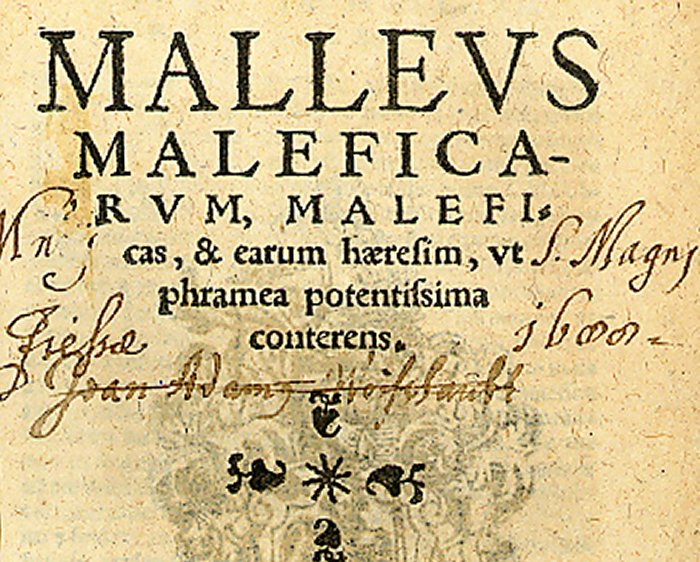
Malleus Maleficarum, the Hammer of Witches, a 1486 treatise on witchcraft. Title page by Heinrich Kramer. Public Domain
This technological advancement could have contributed to the spread of beliefs and fears surrounding witchcraft during that period.
A recent study published in Theory and Society reveals that the printing of witch-hunting manuals, especially the Malleus Maleficarum in 1487, significantly contributed to the spread of persecution throughout Europe.
The research further emphasizes how trials conducted in one city had a notable impact on similar proceedings in other locations. The social influence, particularly the observation of neighbors’ actions, significantly impacted a city’s decision to adopt witch trials.
Kerice Doten-Snitker, a Complexity Postdoctoral Fellow at the Santa Fe Institute and lead author of the study, said that “cities weren’t making these decisions in isolation.”
Instead, “they were watching what their neighbors were doing and learning from those examples. The combination of new ideas from books and the influence of nearby trials created the perfect conditions for these persecutions to spread.”
The witch hunts in Central Europe began in the late 15th century and continued for nearly 300 years. During this period, approximately 90,000 individuals were prosecuted, leading to around 45,000 executions. This historical phenomenon reflects a significant chapter in European history marked by widespread fear and persecution.
Belief in witches and witchcraft had been a part of European culture for centuries. However, the period witnessed an unprecedented level of systematic and widespread persecution.
Doten-Snitker states that the printing press allowed ideas about witchcraft to quickly spread beyond small intellectual circles. The Malleus maleficarum, a notorious publication, served as a guide for identifying and prosecuting witches.
Once circulated, these manuals offered local authorities a framework for managing suspected witchcraft.
For their study, Doten-Snitker and colleagues build on previous research by looking beyond broad economic and environmental factors and focusing on how new ideas about witchcraft spread through social and trade networks, influencing behaviors in a slow but powerful way.
Researchers examined data concerning the timing of witch trials and the publication of witch-hunting manuals across 553 cities in Central Europe from 1400 to 1679. During this period, there was a significant decline in both the frequency and intensity of persecutions.
The research indicates that each new edition of the Malleus Maleficarum was associated with a rise in witch trials. Interestingly, it wasn’t solely the proximity to a printing press that influenced whether a city would hold such trials; the impact of neighboring cities was equally significant.
One city adopted the practices outlined in the Malleus Maleficarum, and nearby cities often followed suit, learning from each other’s actions. This process, which Doten-Snitker and her co-authors term ideational diffusion, often took many years as people in towns and cities needed time to digest new ideas about witchcraft and turn them into behavior.
However, once it took hold it created a slow but powerful ripple effect that percolated across the continent.
As the research focuses on historical witch trials, Doten-Snitker sees clear modern parallels in how large-scale social change occurs.
“The process of adopting witch trials is not unlike how modern governments adopt new policies today,” Doten-Snitker said.
“It often starts with a change in ideas, which are reinforced through social networks. Over time, these ideas take root and change the behavior of entire societies.”
Written by Conny Waters – AncientPages.com Staff Writer