

Jan Bartek – AncientPages.com – Ostrów Lednicki, the largest of five islands on Lake Lednica, located between Gniezno and Poznan in Poland, is of significant historical importance and has been a central focus of researchers. Archaeological findings indicate that the island was inhabited as early as the late 5th and early 4th centuries BC. It later became a core area for Poland’s first rulers during the Piast dynasty’s emergence, blending history with legend.

For many years, scientists have explored the waters of Lake Lednica, which separates Ostrów Lednicki from the mainland—one of the main strongholds of the state of Mieszko I and Boleslaw the Brave. Credit: Mateusz Popek
Extensive studies, including sediment analysis from Lake Lednica, have offered valuable insights into Poland’s early development under Piast rule. The House of Piast was Poland’s first historical ruling dynasty, beginning with Duke Mieszko I (c. 960–992), who is recognized as the first documented Polish monarch. The dynasty’s reign concluded in 1370 with King Casimir III the Great.
Treasure From The Bottom Of The Lake Lednica
Over time, numerous intriguing artifacts have been discovered on Ostrów Lednicki, helping reconstruct aspects of ancient Polish history. In particular, research conducted in 2025 by a team from Nicolaus Copernicus University Centre for Underwater Archaeology (Torun) alongside experts from The Museum of The First Piast Dynasty at Lednica led to an unexpected discovery: four early medieval spears were found during what was anticipated to be an uneventful research season. This significant find stands out as one of the most exciting developments in recent years in ongoing archaeological investigations at Ostrów Lednicki.
The smallest spearhead, rhomboidal in shape, was preserved along with a fragment of an ash shaft approximately 2.1 meters long. “This is rare, as only two spears from Lake Lednica have such a well-preserved shaft,” says Dr. Andrzej Pydyn, professor at Nicolaus Copernicus University and director of the Center for Underwater Archaeology. “The weapon was tipped with an antler ring, making it a unique artifact. Completely preserved spears are rare. Two more are known from this lake, each measuring over three meters in length. This year’s find confirms information, known primarily from iconography, that both shorter and longer spears were used.”

An elaborately decorated spear could have served as a symbol of power, the insignia of a high-born warrior, or a ritual object. Credit: Mateusz Popek
The second spearhead is slender and delicate, featuring a shape reminiscent of a willow leaf—a design commonly seen across early medieval Europe. While this form was widespread, the presence of similar examples within the Lednica complex suggests possible local production and highlights the region’s established tradition of craftsmanship.
The third spearhead stands out as the longest discovered and is characterized by its triangular profile. It was produced using a welded technique, which involves repeatedly forging together soft, low-carbon steel with hard, high-carbon steel. This method results in superior combat properties and reflects the highest technological standards of the period. Spearheads crafted in this manner were utilized throughout Europe.
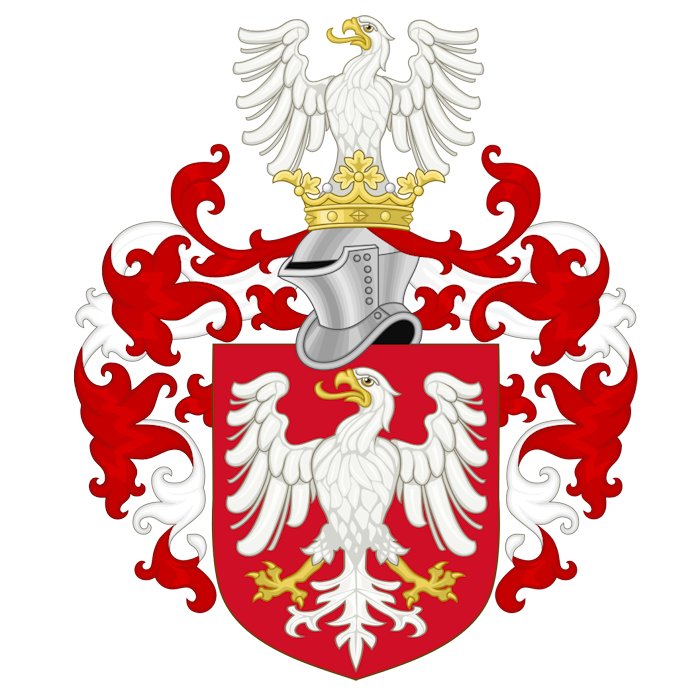
Coat of arms of the Piast dynasty. Credit: Wereszczynski – CC BY-SA 4.0
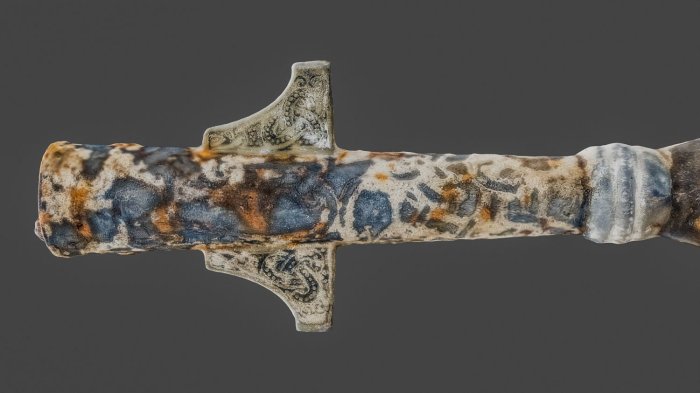
The researchers were particularly intrigued by a richly decorated spear featuring wing-like elements. Its steel head was mounted on an elaborately adorned socket, and much of the spear is plated with gold, silver, bronze, and other metals. The surface displays intricate spiral and triskelion motifs. Based on its craftsmanship and ornamentation, the spear may have served as a symbol of power, an insignia of a high-status warrior, or a ritual object.

Credit: Mateusz Popek
“There’s no doubt that the weapon should be associated with the elite warrior culture of the turn of the 10th and 11th centuries,” emphasizes Dr. Matusz Popek from Nicolaus Copernicus University’s Center for Underwater Archaeology.
“It’s possible the decorations served an identifying function, allowing the weapon’s owner to stand out during ceremonies or battles, and also demonstrated prestige and high social status. The presence of such a high-quality object at Ostrów Lednicki further underscores the special significance of this center, both politically and symbolically.”
Secrets Of The “Princely” Spear
To uncover the secrets of the “princely” spear, Prof. Piotr Targowski from the Institute of Physics and researchers from the Interdisciplinary Center for Modern Technologies at Nicolaus Copernicus University (UMK) used the advanced technique of X-ray macrofluorescence, which reveals the distribution of chemical elements over a large surface area. Such studies not only help decipher the “recipe” of a medieval craftsman but also provide insight into his working methods and artistic sensitivity.
“We hope that the research, along with a detailed analysis of the ornamentation, will allow us to determine where the spear was produced—whether it was made in a local workshop connected to the hinterland of the stronghold on Ostrów Lednicki, or imported from more distant craft centers, perhaps Scandinavian or Russian,” says Konrad Lewek, MA, from the Nicolaus Copernicus University’s Center for Underwater Archaeology. “Determining its origins could provide new data on the trade and political contacts of the early Piast dynasty.”

Credit: Mateusz Popek
Further specialized research in dendrology and radiocarbon dating was also conducted. Analysis of the preserved spear shaft fragments identified the wood as ash, a type commonly used for spearmaking in the early Middle Ages. Radiocarbon dating, performed by Prof. Dr. Hab. Eng. Marek Krapiec from the Absolute Dating Laboratory in Krakow, confirmed the assumed chronology of the find, clearly placing it in the early Piast period.
Where Did This Weapon Come From?
To date, scientists have not been able to definitively determine why so many weapons were found at the bottom of Lake Lednica. Two main hypotheses are currently under consideration. The military hypothesis links the finds to the dramatic events of the 1030s, when the Piast state faced a crisis after the death of Mieszko II.

Credit: Mateusz Popek
According to historical accounts, the Czech prince Bretislaus invaded the country at that time, sacking Gniezno and likely the castles in Poznan and Ostrów Lednicki as well. Some weapons may have fallen into the water during battles on the bridges connecting the island to the mainland or possibly from boats.
Credit: Mateusz Popek
The second, ritual hypothesis suggests that the weapons were deliberately placed in the water as offerings to deities or spirits. Such practices are known from earlier times in many parts of Europe. Water was seen as a gateway to the world of the dead, and throwing a precious object into it carried profound symbolic meaning.
See also: Underwater Secrets Of Lake Lednica And The Unique Wooden Face
The recently discovered artifacts, especially the ornate spearhead, are set to undergo detailed research. In partnership with AGH University of Science and Technology in Kraków, researchers will use X-ray computed tomography—a technique common in metallurgical studies—to scan these objects. This advanced imaging will reveal the internal structure and shed light on the production methods used to create them.
The research is part of a project utilizing the E-RIHS.pl consortium’s research infrastructure, coordinated by Nicolaus Copernicus University. Additionally, isotope analyses will be performed on selected metals from the “princely” spearhead to trace their origins and potentially identify where this prestigious artifact was crafted.
See also: More Archaeology News
After scientific examination, a conservation team led by Dr. Piotr Niemcewicz from Nicolaus Copernicus University’s Department of Conservation and Restoration of Architecture and Sculpture will preserve the spearhead.
This effort involves close collaboration with Lukasz Bronski’s conservation workshop at the Museum of the First Piast Dynasty in Lednica. Once conservation is complete, the spearhead will be featured in an exhibition at this museum for public viewing.
Source: Nicolaus Copernicus University
Written by Jan Bartek – AncientPages.com Staff Writer