

Jan Bartek – AncientPages.com – Four years after the discovery and recovery of a 1,200-year-old dugout canoe from Lake Mendota, archaeologists from the Wisconsin Historical Society, in collaboration with regional First Nations, continue to explore the site’s archaeological significance in Madison, Wisconsin.

Over 16 canoes have been discovered at the bottom of a North American lake. The oldest canoe dates back more than 5,000 years, providing valuable insights into early watercraft construction and ancient human activity in the region. Credit: Wisconsin Historical Society
In 2022, the team recovered another ancient canoe—at 3,000 years old, it is currently recognized as the oldest dugout canoe found in the Great Lakes region. Since then, researchers have identified 14 additional ancient canoes still submerged in Lake Mendota’s bed; notably, six were located in spring 2025.
Why Do We Know About The Ancient Canoes Retrieved From Lake Mendoza?
The two recovered canoes are undergoing an extensive preservation process to ensure their long-term stability. One of these vessels is planned for future exhibition at the forthcoming Wisconsin History Center. Meanwhile, historians and archaeologists are actively investigating the broader history of this underwater site to better understand its context and share its story with future generations.
Wisconsin Historical Society maritime archaeologist Tamara Thomsen has led efforts to chart more canoe locations since her initial discovery in 2021. Working closely with First Nations partners and University of Wisconsin-Madison professor Sissel Schroeder—as well as collaborators like the USDA Forest Products Laboratory—Thomsen has mapped a total of 16 canoes so far. The research includes identifying wood types and estimating ages for each watercraft based on collected samples. Current investigations focus on understanding why particular tree species were chosen for construction and exploring possible reasons behind how these canoes came to be grouped together within Lake Mendota.

A map of the 16 canoes discovered by archaeologists. Credit: Wisconsin Historical Society
“Archaeology is kind of like putting together pieces of a puzzle, and the more pieces you can find, the better you can start to form a picture of what was going on and why during a period of history,” said Tamara Thomsen, Wisconsin Historical Society Maritime Archaeologist. “We can’t go back in time to get answers to our questions, but we can examine the available data alongside knowledge from First Nations and cultural history to form theories to answer our questions.”
A Canoe Older Than The Giza Pyramids And The Oldest From The Great Lakes Region
According to wood type analysis conducted by the USDA Forest Products Laboratory, out of the 16 canoes identified, half were made from either red or white oak. The frequent use of oak—particularly red oak, which is generally avoided in watercraft construction due to its tendency to absorb water—led Thomsen to investigate the reasons behind its selection for canoe building.

The first ancient canoe was discovered in Lake Mendota in 2021. This significant find provided valuable insights into the region’s early inhabitants and their methods of water transportation. Credit: Wisconsin Historical Society
“When you look at the shoreline map with canoe locations charted, it’s clear that there are two distinctive groupings represented,” said Thomsen. “Looking at the tree species taxonomy, we wondered not just why certain trees were used by the builders but also why these canoes were situated in these two locations. Carbon dating from the samples told us that both spots were in use over thousands of years, and so we started to form theories as to why they were left where they were and why certain trees were used.”
Carbon dating, a scientific method used to estimate the age range of organic materials, has revealed that the oldest canoe discovered is approximately 5,200 years old, while the most recent dates back about 700 years. The earliest known Lake Mendota canoe was likely built around 3000 BCE—predating the construction of Egypt’s Great Pyramid of Giza and coinciding with the emergence of writing in Sumer. Made from red oak, this canoe holds distinction as both the oldest dugout canoe found in the Great Lakes region and the third oldest identified in eastern North America.
Theories
Oak wood, along with several other species found in the samples, is recognized for its ability to form tyloses when the tree experiences stress during its growth cycle, such as from wounds or pathogen infections. Tyloses also develop naturally as part of a tree’s aging process. These balloon-like structures form within the wood’s vessels, effectively blocking water movement. This blockage helps prevent the spread of fungi and bacteria, isolates injuries, and protects the wood from decay. As a result, tyloses enhance the wood’s water resistance, buoyancy, and protection against rot—qualities that make it particularly well-suited for boat building.

The oldest canoe found in Lake Mendota predates the Giza pyramids in Egypt. Credit: Wisconsin Historical Society
“It’s entirely possible that the canoe builders were intentionally selecting trees that had been damaged from weather or purposefully wounding them during their growth cycle to induce tyloses. We think of bioengineering as a modern practice, but the samples we have suggest this may have been taking place long before the term was coined in the mid-20th century,” said Thomsen.
The centralization of canoes into two specific groupings appears to be a strategic decision, as indicated by a comparison with mapped trailways used by Indigenous communities. This arrangement likely facilitated efficient travel across the landscape, serving not only for access to lake resources but also for convenient movement between important locations on land.
Evidence suggests that these canoes were communal property rather than individually owned, and they were stored at designated sites. This system is comparable to modern community bike-sharing programs, where bikes are kept at docking stations for shared use among participants.
“The canoes give us insight into a sophisticated travel network and interconnected communities that used their incredible skills and knowledge to live and thrive on lands where we still live and thrive today. They reflect a deep relationship with the environment and the ingenuity of our ancestors,” said Larry Plucinski, Tribal Historic Preservation Officer, Bad River Band of Lake Superior Chippewa, in a press release. “Sharing what we learn from this project honors the innovators whose knowledge lives on and inspires new generations to feel pride for their ancestors.”
Canoes played a significant role in providing access to natural resources from the lake, such as fish, as indicated by the discovery of seven net sinkers with Canoe 1 and three with Canoe 13. In addition to resource gathering, canoes also enabled more efficient travel between communities for trade and allowed people to reach places of spiritual importance like Lake Wingra.
Prior to the arrival of European settlers, the landscape surrounding Madison’s lakes was markedly different; large bluffs made overland travel challenging in some areas. As a result, canoe travel often offered a more practical means of transportation for local communities who inhabited this region for thousands of years before Wisconsin became a state.
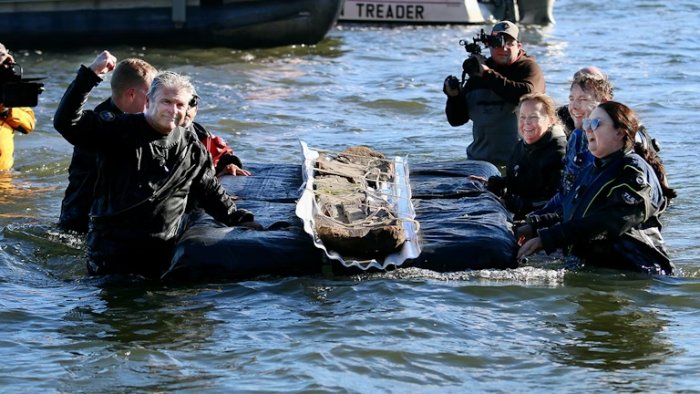
Marine archaeologists with one of the recovered submerged canoes. Credit: Wisconsin Historical Society
“Lake Wingra holds deep spiritual significance for the Ho-Chunk people, whose ancestral lands surround its shores,” said Dr. Amy Rosebrough, State Archaeologist for the Wisconsin Historical Society. “One of its springs, with its white clay bottom, is viewed as a portal to the spirit world. For generations, the Ho-Chunk have honored this place through ceremonies of remembrance, guidance and peace, helping spirits journey to the world beyond. This lake is not just a natural feature but a place of profound cultural and spiritual connection.”
See also: More Archaeology News
“This project gives us a meaningful opportunity to gain a deeper perspective on our heritage and our ancestors. The canoes remind us how long our people have lived in this region and how deeply connected we remain to these waters and lands,” said Bill Quackenbush, Tribal Historic Preservation Officer, Ho-Chunk Nation.
“It is important that we document and share these stories so our youth feel that connection to our past. Protecting and preserving this knowledge ensures that the next generation understands where we come from and why these stories matter. That is why we share them and continue this work.”
Written by Jan Bartek – AncientPages.com Staff Writer