

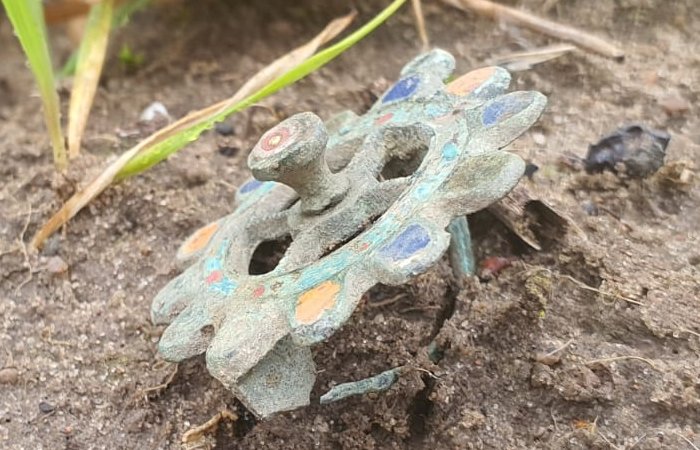
Jan Bartek – AncientPages.com – A remarkable ancient fibula was recently discovered near the former royal city of Grudziadz in Poland, marking only the second time such an artifact has been found in the country.

Credit: Grudziądzkie Stowarzyszenie – Image compilation AncientPages.com
This significant find was made by metal detectorist Patryk Budzinski and his team from the Grudziadz Fortress Association, a group dedicated to uncovering historical artifacts. The site yielded not only this unique brooch but also traces of other artifacts associated with various cultures, suggesting that it may have once been an ancient settlement with a burial ground.
The discovery process began when Budzinski received a photograph of the fibula. Initial identification proved challenging until archaeologist Piotr Duda, president of the Triglav Historical and Research Association, provided expert guidance.
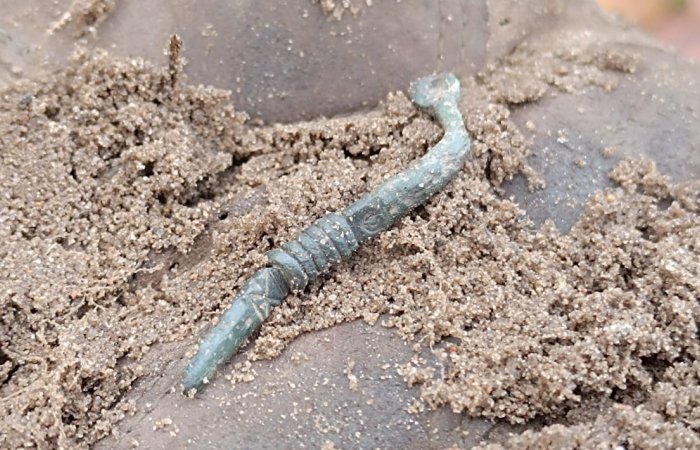
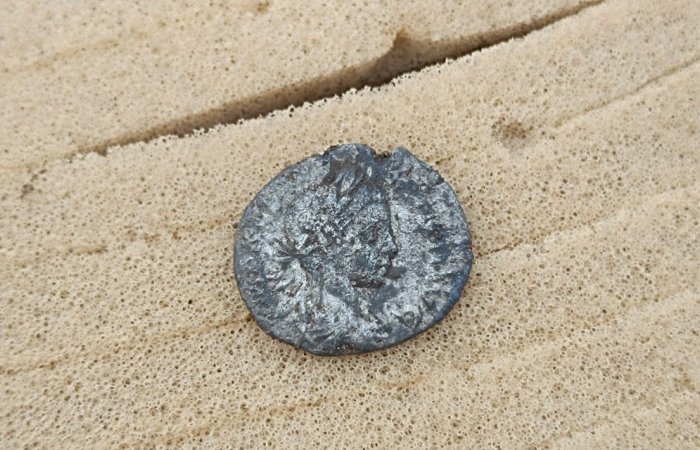
In addition to this enameled brooch, previous searches in the area have uncovered several other notable items: different types of fibulae, Roman pottery, a cosmetic spoon, a Scythian spearhead (possibly indicating past invasions), fragments of belt pendants, a spur, hair ornaments, and even a Teutonic coin. These findings highlight both the region’s multicultural history and strategic importance—especially given its proximity to the historic Amber Road trade route.
Credit: Grudziądzkie Stowarzyszenie
Currently available information on this particular fibula is limited; however, it closely resembles another example from the Babi Dól-Borcz cemetery in northern Poland. That earlier find was excavated from a young girl’s grave alongside three other brooches and various personal items. The two brooches share similar designs—a circular disc with a central knob decorated with colored enamel—but differ slightly in size and number of protrusions.
Credit: Grudziądzkie Stowarzyszenie
Archaeological evidence suggests that these artifacts date back to the first centuries AD and are associated with the Wielbark culture (1st–5th century AD). The Wielbark culture is historically linked to the Gothic peoples who migrated from Scandinavia into what is now Poland. They played an important role along trade routes like the Amber Road and maintained cultural connections both locally and with southern Scandinavia.
Credit: Grudziądzkie Stowarzyszenie
Over time, they replaced earlier cultures such as Oksywie on the lower Vistula River before expanding southward at the expense of neighboring groups like those associated with Przeworsk culture.
This discovery not only enriches our understanding of early Polish history but also sheds light on broader patterns of migration and cultural exchange across Europe during antiquity.
See also: More Archaeology News
According to Marta Wajszczak from Zwiadowca Historii, enameled brooches were manufactured across all Roman provinces, with significant production centers in Gaul, Rhaetia, and the Danubian and Rhineland regions. These brooches date from the late 1st to the late 2nd century AD. Primarily worn by children—especially girls—these colorful accessories served not only as decorative elements but also functioned as toys or amulets.
All discovered brooches have been adequately secured and reported to the Provincial Conservation Office. Following conservation efforts, these artifacts are scheduled for exhibition at the Museum in Bydgoszcz.
Source: Zwiadowca Historii
Written by Jan Bartek – AncientPages.com Staff Writer