

Jan Bartek – AncientPages.com – After six years of excavation at Tell El-Farama in North Sinai, archaeologists have uncovered a rare water-focused ritual complex dedicated to the local deity Pelusius. This discovery is prompting scholars to reassess long-standing assumptions about the ancient city of Pelusium and its importance in antiquity.
Credit: Ministry of Tourism and Antiquities
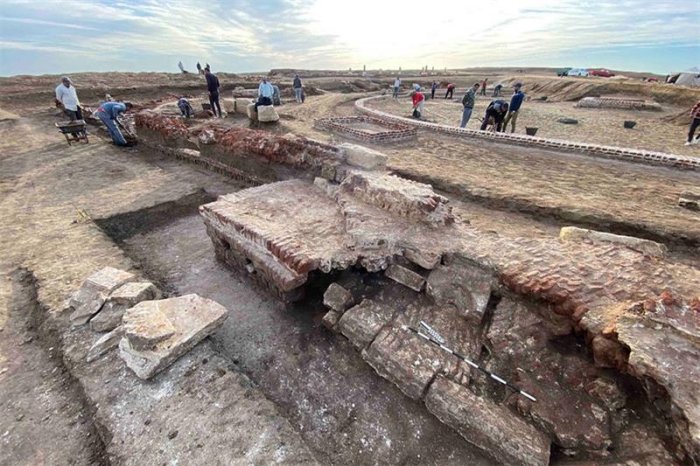
The team from Egypt’s Supreme Council of Antiquities (SCA) has identified a structure unlike any temple previously known at the site. Its remains indicate a sacred installation organized around water-based rituals, suggesting that religious practices in Pelusium were more specialized and complex than previously thought. As a result, researchers are revisiting earlier interpretations of the city’s function and status, marking a significant new phase in the study of Pelusium’s historical role.
Minister of Tourism and Antiquities Sherif Fathy has framed the discovery as a powerful reminder of North Sinai’s archaeological richness, noting how much the region still has to reveal. His remarks highlight the importance of sustained excavation and careful scientific research, both for deepening our grasp of the past and for nurturing ongoing academic exploration.
Credit: Ministry of Tourism and Antiquities
Hisham El-Leithy, Secretary-General of the SCA, emphasized that the find illuminates Pelusium’s position as a crossroads for the movement and exchange of ideas in the ancient world. Architecturally, the structure weaves together ancient Egyptian traditions with Hellenistic and Roman elements, reflecting the layered cultural interactions that shaped Egypt in its later periods and inviting renewed reflection on how such encounters transformed the landscape of belief and practice.
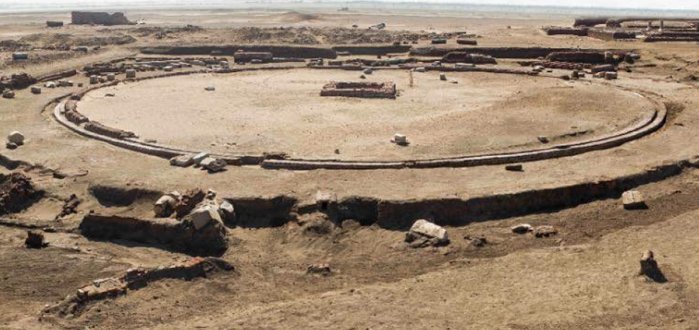
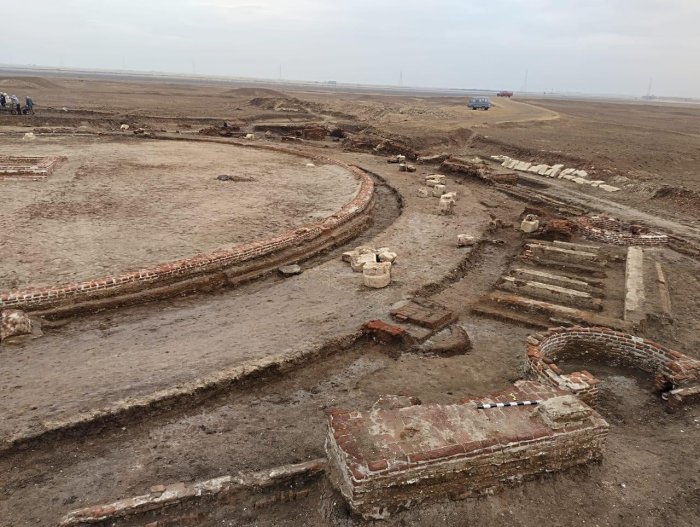
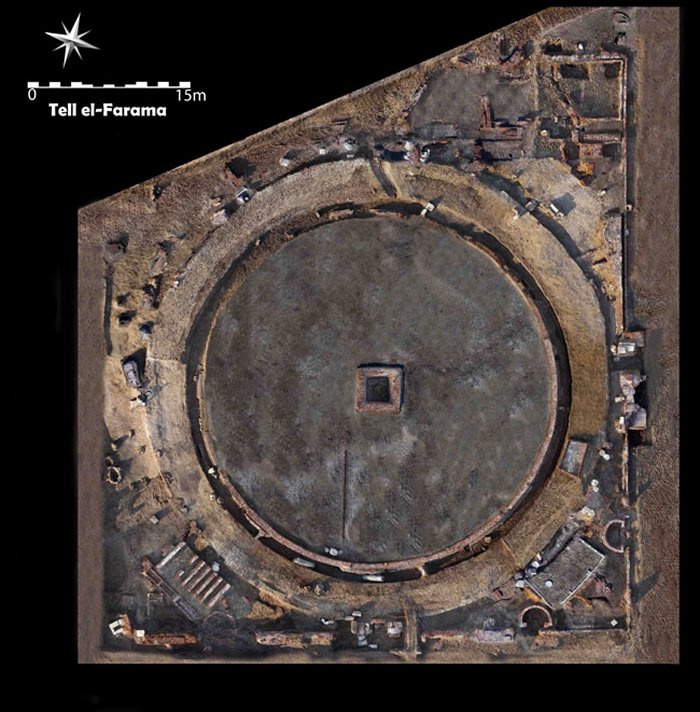
At the heart of the complex lies a great circular basin, about 35 meters across—a powerful reminder of how deeply human beings have always been connected to water, nature, and the divine.
Fed by the Pelusiac branch of the Nile, its silt-rich waters were more than just a practical resource; they were a living symbol of the god Pelusius, whose very name comes from the Greek word pelos, meaning “mud.” From something as humble as mud, entire worlds of meaning and belief were shaped—proof that even the simplest elements of the earth can become vessels of the sacred.
Credit: Ministry of Tourism and Antiquities
Around the basin, an intricate network of water channels carried the flow away, a testament to the ingenuity and vision of those who designed it. At the center, a square platform likely held a monumental statue of the deity—a focal point of devotion, reflection, and awe, where countless individuals stood, wondered, and reached beyond themselves.
Archaeological evidence reveals that this sacred structure endured for nearly eight centuries, from the 2nd century BCE to the 6th century CE, with only minor changes over time. Across generations, through shifting cultures and empires, people continued to gather around this place. It stands as a moving reminder that while centuries pass and civilizations evolve, our search for meaning, connection, and the sacred remains beautifully constant—and that, like those who came before us, we too are part of this long, unbroken journey toward understanding who we are and what we hold sacred.
Credit: Ministry of Tourism and Antiquities
According to mission supervisor Hisham Hussein, the understanding of the site has changed substantially as excavations progressed. When work began in 2019, archaeologists uncovered only about a quarter of a circular red-brick structure. Based on this limited evidence, they initially identified it as a senate building.
As excavation continued, however, a much more intricate plan emerged. The structure was found to include multiple entrances and a sophisticated hydraulic system, indicating a function more complex than a civic assembly hall.
See also: More Archaeology News
To clarify the building’s purpose, the research team combined a detailed on-site investigation with a comparative analysis of similar constructions from the Hellenistic and Roman periods. This process led them to reconsider their original interpretation. Their revised view was strengthened through academic collaboration with international specialists, including Jean-Yves Carrez-Maratray of Sorbonne University. These experts confirmed that the building was not a civic monument but a sacred complex associated with water-related religious rituals.
This finding not only changes the architectural classification of the structure but also highlights Pelusium’s role as an important center of religious innovation and cultural interaction in the ancient Mediterranean world.
Source: Ministry of Tourism and Antiquities
Written by Jan Bartek – AncientPages.com Staff Writer