

The “not too distant future” of Hirokazu Kore-eda’s Sheep in the Box closely resembles our present, with a few notable advancements. Delivery drones litter the sky, robots help kids cross the street, and reliance on AI has progressed far enough that tech companies are marketing it as a salve for grief.
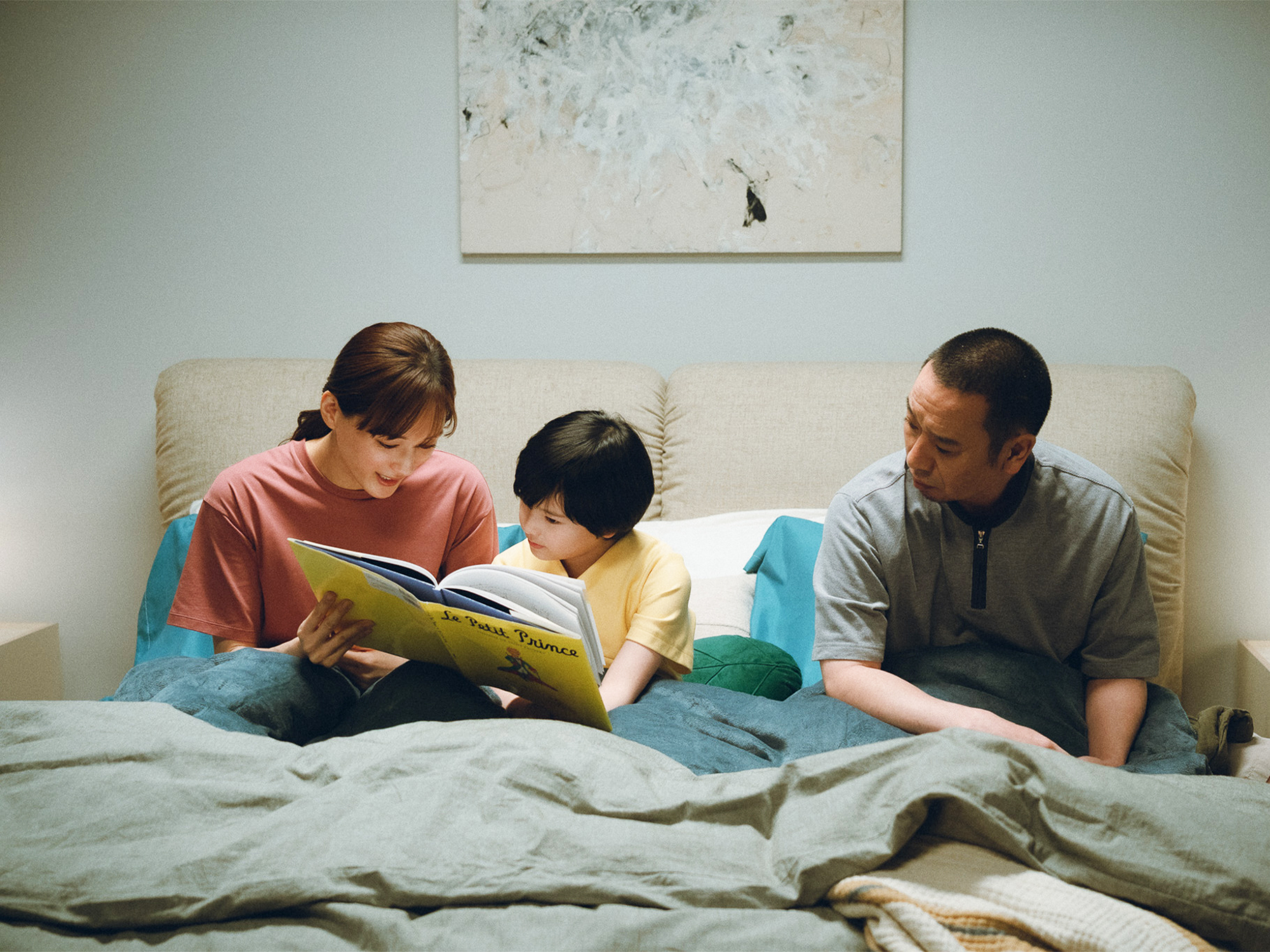
Otone (Haruka Ayase) and Kensuke (Daigo Yamamoto) are a married couple still recovering from the loss of their seven-year-old son Kakeru when they receive a hologram ad in the mail from REbirth, which offers humanoid robots to assume the place of deceased children. Though they’re somewhat reluctant to accept the offer at first, they change their minds when they meet a robot child at the company’s headquarters that appears more human than metal and wires under silicon. And so the new Kakeru (played by Rimu Kuwaki, continuing the grand Kore-eda tradition of remarkable child performances) arrives at their doorstep as if he never left. Otone spends as much time as possible with Kakeru, while the more cynical Kensuke would prefer his surrogate son to call him “ojisan” instead of “papa”.
Get more Little White Lies
Sure, robot Kakeru looks exactly like their child, but as they become acquainted with him, the limits of AI in replicating humanity become apparent. That uncanniness is present in the way he can rattle off facts about the life cycle of trees, or provide the ETA to the nearest train station like a humanoid Google Maps. But Sheep in the Box isn’t necessarily anti-generative AI so much as it advocates for a harmonious existence between technology and nature. (Mileage with that proposal may vary.) It’s also clear that these robots aren’t a genuine replacement for children, but a product of something as slippery and unreliable as memory: in supplying audio and videos to build Kakeru’s personality, Otone and Kensuke carefully select only the happy ones, and nothing that relates to his death in a train-related accident.
In that sense, the restrained sci-fi and family drama of Sheep in the Box is contained within a fairly standard grief metaphor. In adopting Kakeru, Otone and Kensuke grip onto a halcyon version of their son who doesn’t exist, and are unable to move on while a perennial reminder lives in their home.
There are shades of Kore-eda’s humanist dramas – the complicated familial relationships of Like Father, Like Son; the hardened resilience of children in Nobody Knows – but the director’s latest fails to reach the tender heights of those films. The result is unfocused, getting lost in increasingly dramatic tangents that are only vaguely explored, like the circumstances of Kakeru’s death or a string of kidnappings.
That scattered approach extends to the strange pacing. Kore-eda has always been a generous and open-hearted filmmaker but any signs of conflict quickly evaporate without a trace: Kensuke immediately sheds his skepticism the first time he finds common ground with his son, and Kakeru’s programming, which prevents him from feeling pain or sadness, removes any emotional weight from his weakening relationship with Otone. The film later rushes to its conclusion in a way that demands you swallow the baffling leaps in logic in Otone and Kensuke’s decisions. In attempting to traverse the full spectrum of grief, the emotion of Sheep in the Box is flattened – a rare miss from one of our great sentimentalists.