

Jan Bartek – AncientPages.com – Several thousand years ago, extensive excavations took place throughout Denmark.
Thousands of holes, each 30 to 40 centimeters deep, were dug in belts three to six meters wide and sometimes several kilometers long.
This phenomenon is known as ‘hole belts.’ During the early Iron Age (500-300 BCE), they were primarily constructed in Denmark, especially in Central and Western Jutland, as well as on Funen and Lolland.
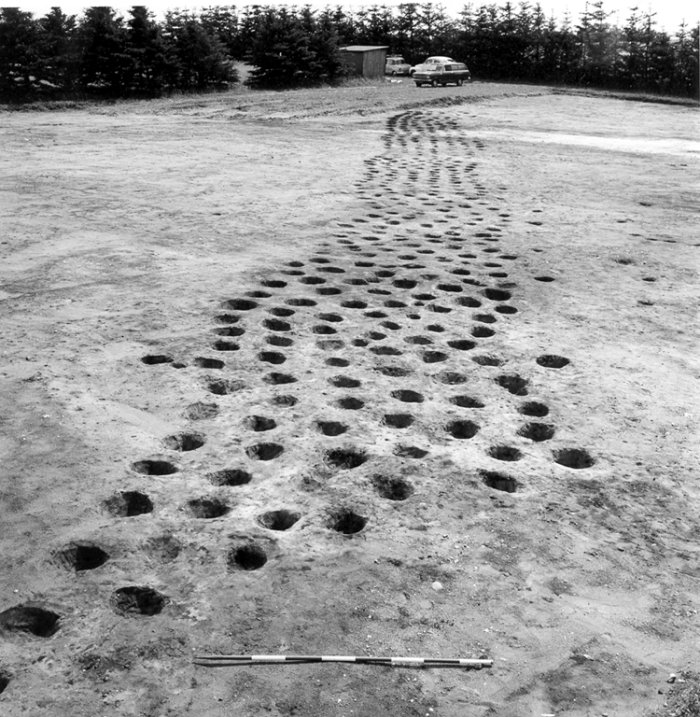
The Grønbæk hole belt in Ringkøbing-Skjern was among the first to be found in the 1960s, when archaeologists first noticed this phenomenon. Credit: Ringkøbing-Skjern Museum
To date, nearly 50 hole belts have been discovered in Denmark. However, their purpose remains unclear.
“The holes were too small for you to bury anyone in them, so they were definitely not burial grounds,” says Henriette Lyngstrøm, associate professor at the Saxo Institute at the University of Copenhagen.
“They may have served as defensive structures or for food storage. Several theories exist regarding their purpose, but we do not have a definitive answer.”
To study these ancient hole belts, she has brought together a team of 30 archaeology students. They will make tools, dig a hole belt, and try using it in different ways to see what the hollow belts could and could not be used for.
Students are actively excavating the hollow belt in front of the Iron Age village at the Land of Legends Lejre.
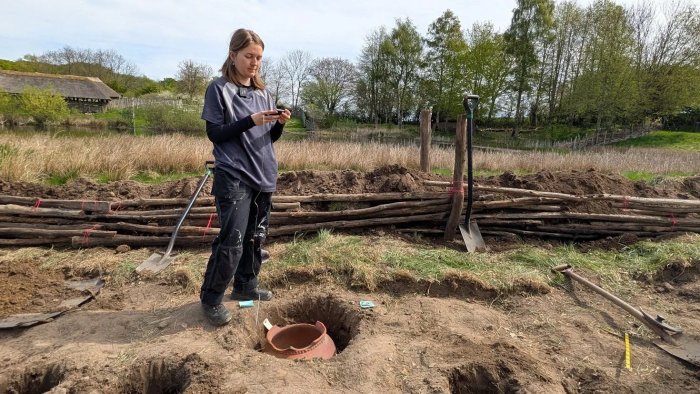
The hole belts may have served various purposes. It is possible that one functioned as an Iron Age refrigerator. Credit: Kasper Vegeberg / Videnskab.dk
Some use authentic wooden shovels, while others use modern tools. Others observe and document the progress.
At the edge of the hole belt, Angelyn Sørensen, a master’s student in prehistoric archaeology, monitors a meat thermometer with a wire extending into one of the holes.
“Ceramic shards and the bottom of a clay vessel have been found in a hollow belt in Lystbækgård, in West Jutland,” she says.
“This can be interpreted in several ways. One interpretation could be that the holes were used to store food – a kind of refrigerator.”
To test this, Angelyn Sørensen placed a chicken at 10 degrees Celsius in a ceramic jar, covered it, and continuously monitored the temperature.
“The temperature has risen to about 12 degrees during the day, so it’s actually holding the temperature fairly well,” she concludes.
It is a warm May day, with outdoor temperatures reaching 20 degrees.
Although 12 degrees is not ideal for storing chicken, she maintains that the experiment demonstrates the perforated belt could have been used to keep food cool.
“It could have been seasonal, for example in the fall, when it is generally colder,” she assesses.
However, they have also tested whether the pottery shards could be used to dig up soil, and, according to Angelyn Sørensen, they proved to be “extremely effective” for this purpose.
“I think the hole belts have had different functions in different places. The refrigerator function is still a possibility.”
At the far end of the pit belt, graduate student Clara Thejls observes the excavation with a wooden shovel in hand.
“Many of these wooden shovels from the Iron Age have been found, but we don’t know exactly how they were used,” she says.
The spades are wooden, flat at both ends, and feature a central handle. Clara Thejls notes that archaeologists once believed they were oars.
However, the asymmetrical ends make them impractical for paddling in a straight line.
Soil and pebble remains found in the frayed ends indicate they were used for digging pits and related tasks.
This is what Clara Thejls is testing today.
“We want to see how long it takes to dig holes with wooden shovels and how much energy it requires.”
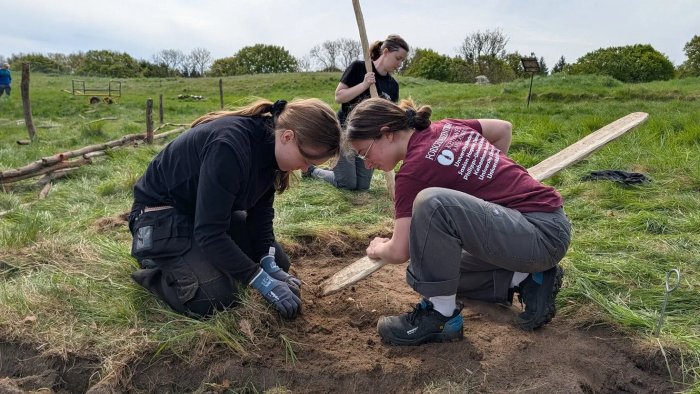
Clara Thejls and several classmates use wooden shovels to dig holes, while another group uses modern shovels to measure differences in productivity.
“It’s definitely harder to work with the wooden shovels, and it takes longer. Partly because they have to be sharpened with an axe every now and then, and metal shovels don’t have to.”
What is your initial conclusion? Do you believe people historically used these wooden shovels to dig pits?
“I can imagine they used them. But it’s hard, so I understand why people have moved away from it.”
The process in which archaeologists recreate and test archaeological finds is known as ‘experimental archaeology,’ a method strongly supported by Henriette Lyngstrøm.
“It’s something I think every archaeology student should do. There are things you just can’t read in a book or on a screen. You have to get out there, feel it for yourself, and try it out.”
For example, in 2015, she and a group of students tested the hypothesis that the hole belts were designed to contain cattle and sheep, as these animals typically avoid crossing holes.
This hypothesis was disproved when the animals crossed the hole belt without hesitation.
Credit: Kasper Vegeberg / Videnskab.dk
Henriette Lyngstrøm states that the experiments have already deepened her understanding of the Iron Age.
“We’ve already gained insights into the social structures related to work,” she says, as the students gather around the hollow belt.
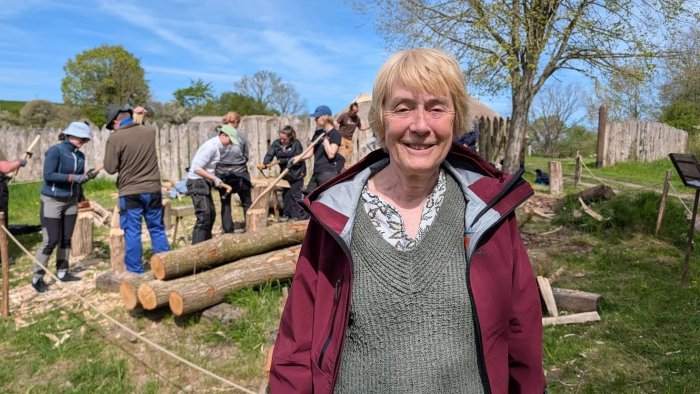
Henriette Lyngstrøm has gained valuable insights from the experiment, even before its completion. Credit: Kasper Vegeberg / Videnskab.dk
“If too many people dig a hole, it becomes inefficient. The process requires clear leadership and coordination, indicating a likely hierarchical structure.”
Henriette Lyngstrøm and the students will publish the Lejre experiments in a forthcoming scientific article.
See also: More Archaeology News
The project continues beyond this point. “One hypothesis is that the hollow belts served as defensive structures, which we also intend to test.”
Afterward, Videnskab.dk spoke with Clara Thejls, who confirmed that the results aligned with expectations:
“We found that it worked well for those who had to defend themselves.”
“Attackers found it challenging to fight and maintain balance, while defenders were able to counterattack effectively.”
Source: Videnskab.dk
Written by Jan Bartek – AncientPages.com Staff Writer