

Jan Bartek – AncientPages.com – Researchers find surprising links showing that Neanderthal ancestry influences our immune system today in ways more nuanced than previously recognized.
Viruses account for an estimated 10-20% of the global disease burden. Many DNA viruses can persist in the body for a lifetime, and virus load varies greatly even among people without symptoms. Throughout human history, they have posed persistent and rapidly evolving threats, placing strong adaptive pressure on our immune system.
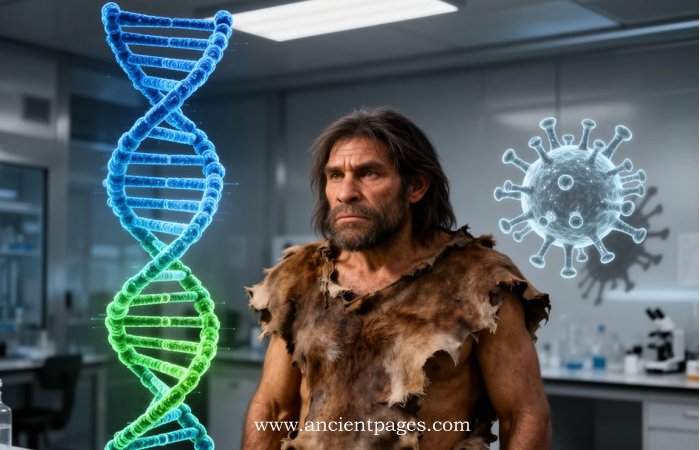
Previous research has demonstrated that many genetic variants involved in immunity bear the marks of these evolutionary battles – including signatures of natural selection and contributions from interbreeding with archaic humans. While Neandertal ancestry has previously been associated with beneficial effects in RNA virus defense, the new study highlights a contrasting trend for DNA viruses.
Because of past admixture with archaic humans, around 2% of the genomes of present-day non-Africans is composed of Neandertal DNA, and an additional 2-4% of people in Oceania are of Denisovan ancestry. These introgressed sequences have shaped many biological traits, including immunity. But their role in defenses against DNA viruses has remained largely unexplored.
Modern Disadvantages Don’t Imply Ancient Harm
RNA and DNA viruses differ fundamentally in their biology, including infection strategies, tissue tropism, and evolutionary rates. These distinctions suggest that archaic genetic variants may influence responses to DNA and RNA viruses differently. To examine this, the team assessed the impact of archaic DNA, primarily Neandertal ancestry, on DNA viral load in UK Biobank participants. By analyzing viral sequences from large-scale genomic data, the researchers investigated whether archaic variants correlate with the presence or quantity of common DNA viruses.
The study identified several associations between archaic DNA and the loads of Epstein-Barr virus (EBV), Human Herpesvirus 7 (HHV-7), and Teno family anelloviruses. These widespread viruses often persist as chronic infections. Overall, archaic DNA was more frequently linked to higher viral loads. While these viruses are often asymptomatic, viral DNA levels can indicate how well the immune system controls them.
“Our results suggest that Neandertal-derived variants may not provide effective defense against several DNA viruses in people today,” said Associate Professor of Evolutionary Genomics Michael Dannemann, a co-author of this study.
“This stands in striking contrast to their previously reported beneficial effects on RNA virus immunity,” he added. However, the researchers emphasize that these negative effects in present-day populations do not mean that the same variants were harmful to Neandertals themselves. “Viruses evolve extremely quickly,” noted Dannemann.
“The pathogenic landscape faced by Neandertals tens of thousands of years ago would have been vastly different from the one we face today. A variant that reduced viral burden in the past may increase it now,” he explained. Supporting this idea, the team identified genomic regions carrying archaic variants that show shifts in selective pressure over time, including signatures of more recent negative selection. These evolutionary signals align with the possibility that once-beneficial archaic alleles have become disadvantageous in today’s environments.
See also: More Archaeology News
The findings show that archaic DNA in people today interacts with modern pathogens in distinct ways, and its effects can vary significantly between virus classes. This research demonstrates that archaic genetic ancestry continues to influence our immune system, though in more nuanced ways than previously recognized.
The study was published in GBE – Genome and Biological Evolution
Written by Jan Bartek – AncientPages.com Staff Writer