

His first poetry collection at nineteen, his second at twenty-two, then a collection of award-winning prose, at twenty-five – the geography of Artur Dron’s life is already remarkable. Born and raised in Pidmykhailivtsi in the Ivano-Frankivsk region, he studied at the Ivan Franko National University of Lviv. Then the start of the full-scale invasion interrupted his journalism Master’s studies; Dron became a serviceman, with the call sign ‘David’, after the biblical combatant of Goliath, in the 125th Territorial Defence Brigade in eastern and southern Ukraine, where he was wounded in October 2024. Since then, he has been receiving medical treatment in Lviv, where he continues to write.
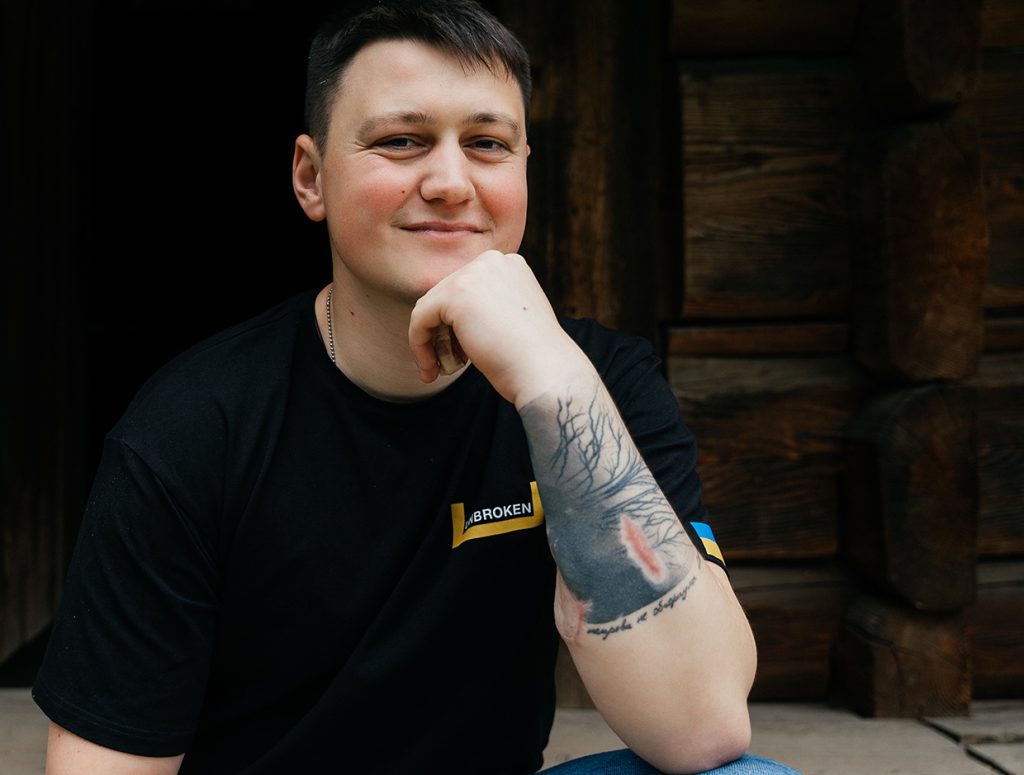
Artur Dron. Photo by Halyna Zvarych
Olena Pshenychna: When I asked if there was a special place for you where you would like to talk, you invited me here, to the courtyard at St John’s Lavra of the Studite Monks within the Ukrainian Greek Catholic Church in Lviv. Why here?
Artur Dron: This is the most peaceful place for me. I’ve been coming here since 2019 to see Father Vsevolod, who is, you could say, my spiritual mentor – ever since I was 17 or 18, especially during what was quite a wild time for me. I would come here to seek advice on my problems, and it was an oasis of calm for me – no matter what I was doing, no matter what happened, and regardless of the hustle and bustle of my student life. This place became even more valuable to me once I joined the army. I would come back on leave from time to time and drop by to see the monks, talk with them, and just sit in quiet. I treasured that deeply. You can really think differently here; it brings me a sense of absolute peace.
Olena Pshenychna: In your writing, you speak a lot about God, about faith, and about what that faith rests upon – or perhaps ceases to hold onto – in a time of war. What is faith – and not just in a religious context — to you? Can a person live without faith?
Artur Dron: Once, at one of the readings we held in various cities, I was asked what I was most afraid of. And it was the first time I had really thought about it. I think I said then that, perhaps, my greatest fear is completely losing faith in anything. I think it is deeply frightening when you believe in nothing at all. And this isn’t just in a religious sense, it’s not just about faith in the God you worship – it’s about faith as a whole. Because if you have nothing to believe in, life is, to a large extent, devoid of meaning.
Olena Pshenychna: In your words about faith, particularly in your writing, one senses a great deal of emotion; somewhere between the lines, you quite boldly reproach the Lord. What is your relationship like now?
Artur Dron: We have encountered things we do not fully understand. And when we do not understand something, it is only natural to turn to the One who is supposed to understand everything. Obviously, we sometimes air our grievances with ‘Him’. The fundamental question when it comes to the theme of war and God is: why does He allow this? There is a temptation, as it were, to shift all responsibility onto Him. But we cannot blame Him for starting this war. It was started by specific people, by the Russians specifically. It is not God who is killing our people, but them. Sometimes, when faced with loss, it is incredibly difficult not to cross the line from asking ‘why did You not save him?’ to ‘why did You kill him?’. It was not God who killed our brothers-in-arms, or someone’s children, husbands, or loved ones. They were killed by specific people, specific Russians who made that choice.
It would be easier if we knew that, say, God had simply set the world and all its processes in motion – where wars happen in one place, good things happen in another, and He adheres to a principle of non-intervention.
It would be easier that way, but I realize that He does intervene after all. Even from my own experience, I see many moments that are difficult to describe as anything other than God’s intervention. And that, in fact, is my main point of contention with Him: why do You intervene and help in one situation but not in another? For example, the story of my injury. I could tell myself that I survived that day and did not perish because God saved me. But if I utter those words, then I am forced to admit that He did not save my friend. And I do not want to say that; I am looking for some other answer. This is not about anger towards Him; it is about a genuine struggle to understand.
Olena Pshenychna: But are we talking about a total loss of faith, and what, despite everything, does it still rest upon for you?
Artur Dron: I think that if you already know God, you cannot lose faith entirely, but you can take a wrong turn in your communion with Him. I like to remind myself that, after all, humankind and God exist on very different planes. That is to say, we are like children learning our multiplication tables, whereas He is like a Nobel laureate in physics or mathematics. We think you cannot subtract five from three because there is only zero and nothing exists below it, while He is already operating with negative numbers and infinities. Perhaps these are primitive comparisons. But what I mean to say is that, within this disconnect, to avoid losing heart and reducing your faith to nothing, you have to remind yourself that you are on different planes, in different categories. In reality, there are so many things that are perfectly clear to God that we have yet to comprehend.
Olena Pshenychna: In your book of prose, Hemingway Knows Nothing, you introduce a definition: ‘the Trench God’. How does He differ for you from the Lord outside the trenches? Especially now, when during your rehabilitation you find yourself between two worlds: the civilian and the military.
Artur Dron: When you find yourself at the war-war, in the trench-trench, so close to mutilation and death, everything superfluous – all the extra layers – is stripped away. Only what matters most remains. Sometimes, even thoughts of country or nation are stripped back. There is only your family, a person you love, the person right next to you. And when someone who believes in God finds themselves in these circumstances, their dialogue with Him is, in fact, just like that – completely unlayered. As sincere as possible, and louder than usual. Quite often, questions like ‘where is God when this is happening to us?’ simply fall away, because out there, God is felt very clearly. He is, in fact, right there with you, by your side.
And when you find yourself in this in-between world, you draw the most faith, strength and calm from those who have inhabited both sides of this world. I first felt this in 2023, when I came home on leave, and two of my brothers-in-arms were here in Lviv. We, people from that world of war, met each other for the first time in a different, civilian world. That meeting, that conversation – it was one of the calmest and most normal moments of my leave. And when I came here for treatment after being wounded, a number of my closest brothers-in-arms happened to be in Lviv: some already discharged, some also undergoing treatment, others in rehabilitation. I spent a lot of time at the hospital, where there were many other wounded servicemen, and I spent it talking with them.
People often say that when veterans return from war, they have a heightened sense of justice, a greater level of sincerity and generosity; having spent so long with the superfluous stripped away, we learned in those existential conditions to share everything, to stand up for one another, to see everything as if laid bare. In truth, we brought all of that back with us here. And in this context, sometimes it makes things harder for us in the civilian world, which is why it is so important to stick together.
Olena Pshenychna: In 2022, you often spoke of losing another kind of faith – faith in poetry. You even wrote: ‘literature won’t kill anyone, a poem cannot shield you from a bullet.’ At the start of the full-scale invasion, you stopped writing altogether. Why did poetry cease to matter back then?
Artur Dron: Because at that time, something more practical became important, something from which we could see a tangible benefit in the context of our survival. And it wasn’t just about poetry. I think many of us who were engaged in some pursuit that, on 24 February 2022, could not harm the enemy or protect you and those you love – that pursuit seemed completely pointless to us.
I can’t even imagine myself thinking on that day: ‘Right, let’s stop and write a poem, because this needs to be recorded for future generations.’
Back then, we were looking for ways to volunteer, to be of use. Plus, we were immediately thinking about joining the military. The very last thing on my mind was that some verbal response of mine to what we were experiencing could be of any use. I wrote my first poem after the start of the invasion (it’s in the poetry collection We Were Here, titled ‘Trisagion’) when we saw the news about the maternity hospital in Mariupol. And so I wrote for the first time in March – perhaps rather emotionally, impulsively – and then didn’t write anything at all until the end of August or September.
Olena Pshenychna: Yet you wrote the poetry collection We Were Here as a soldier, right on the front line. You dedicated it to your brothers-in-arms, and the epigraph features the words of one of them: ‘Write about what is inside us.’ At what moment did you feel your faith in poetry returning after all?
Artur Dron: It was when everything had truly been cut off. We were already near Kramatorsk, but we weren’t yet engaged in combat; we were digging a defensive line in case of a breakthrough by the Russians. So, it was a gradual entry into the war. By then, I was already thinking a lot about literature; I had started reading again, because before that, I hadn’t been reading at all. And, in fact, when everything superfluous was stripped away, whenever one of my brothers-in-arms said or did something special, I would catch myself thinking: oh, this is literature, this should be written down; maybe someone else would see something powerful in this for themselves, too.
And sometimes things happened that showed me literature is more serious and greater than I had thought. I like to give the example that is actually in the collection, the piece involving Taras Shevchenko, when I saw the news of how Balakliia was being liberated. The guys recorded a video of them tearing down a propaganda Russian poster and finding Shevchenko underneath it, with these lines: ‘Fight on, and you shall overcome! God helps you in your struggle.’ It amazed me so much and caught me completely off guard. It was as if I were arguing with that ‘professor’ of mathematics who says you can’t subtract five from three. But when I saw this Shevchenko, I understood that negative numbers exist, that there can be minus two, and that the problem wasn’t in the equation but in my own lack of understanding. In other words, if something written by someone two hundred years ago returns to you in such a mystical, incomprehensible way – which you couldn’t describe in any book because people would call it a cliché – then that means it is what matters most. And this news triggered a chain of other thoughts about literature in me.
I recalled how our literary canon returned to us during the Revolution of Dignity, how we depicted them in those helmets with Molotov cocktails, how people quoted them just before they died.
And so I became convinced that, perhaps, the problem lay not with literature but in the fact that I hadn’t grasped its true scale.
Or another example, which I also mention in my book: when a brother-in-arms of mine was killed, his wife wrote a poem on the very day she learned of his death; she is a poet herself, writing spiritual poetry. They were a deeply faithful, religious family. And I thought to myself: if a person, while losing what matters most, can find the strength to turn to creative expression, then perhaps, once again, the fault does not lie with the ‘minus five’ equation, but in my failure to understand that minus and plus infinity exist as well. Over time, I changed my attitude towards literature and realized that I had underestimated it.
Olena Pshenychna: Writing poetry on the front line – what was it for you: a reaction to events, to people, or a desire to enshrine them?
Artur Dron: It varies greatly. One piece might stem from a desire to enshrine something that happened to us, so it becomes immune to time and remains forever. Another piece comes when one of my brothers-in-arms says something so powerful that I couldn’t bear for it to just be spoken and vanish, because I realized that, without even knowing it, he was speaking literature. Some texts are parting words for people who are no longer here, who have fallen. An attempt to convert the most vital thing you saw in them into another dimension. Like in that poem about my brother-in-arms Ivan and his bicycle. I mean, a poem cannot compensate for his death – we shouldn’t demand that poetry compensate for anything – but it can capture a fraction of that grown man’s childlike sincerity and his dream of a bicycle. After all, one of the aims of this book is to tell what is inside us.
Olena Pshenychna: When people ask you about the poetry of Artur Dron, the civilian, versus Artur Dron, the soldier, you say your language has changed fundamentally. What, for you, defines literary language, an author’s voice? What was it like before, and what is this language like now?
Artur Dron: I have one principle, and it remains unchanged – to write about what matters most to you. Maybe it won’t be some popular topic that gathers millions of reactions on Facebook, but writing about what is most important to you is a surefire guarantee that your text will be sincere and truthful. I adhered to this principle during my student days with my book Dormitory No. 6, and when I became a soldier with the collection We Were Here, and I adhere to it now. But since these most vital things were constantly changing, they naturally brought about a change in language as well.
With the first book, the most important thing for me was observing a young and free life – first infatuations, heartbreaks, love, arguments, when people find one another and push each other away. Very youthful, often clichéd, lyrical, romantic things. That was what mattered most to me, and that is what I wrote about.
Obviously, by 2022 or 2023, something else had become paramount: the constant edge, this experience of goodbyes, a deeply intense longing across the distance from those you love, and a kind of profound brotherhood with people you didn’t even know until recently. And this is so entirely different from what I wrote before that it simply had to bring a change of language with it. It became more laconic, more categorical, more clipped.
Every word in poetry carries weight, and when writing poetry, especially at war, every word must be treated as if it might be the last one spoken. You don’t know what tomorrow will bring or what will happen in thirty seconds. And if you approach every text as if it’s the last thing you will ever write and say in your life, it guarantees ultimate openness and truthfulness. This existentialism, this liminality, increases the weight of those words, stripping away everything superfluous. I’ve noticed that in our conversation today, this stripping away of the superfluous has come up often – both in the topic of God and in literature or the military experience. But it really all comes down to this: when the superfluous disappears, a very high level of sincerity emerges in your language.
Olena Pshenychna: We often see on social media that Ukrainian soldiers read even in dugouts. What does reading in such circumstances give you? Whom did you read on the front line, who kept you grounded, and from whom did you draw faith?
Artur Dron: Being at war doesn’t mean reading only what will boost your morale or level of national consciousness. In war, just as in civilian life, reading can be a form of entertainment, a way to fight boredom. I will share two examples.
The first happened in the autumn of 2022. We were sitting in a trench beyond Torske, on the front line, and I was reading aloud from an e-book on my phone—Stanislav Aseyev’s The Torture Camp on Paradise Street. It was as if we were already in difficult circumstances, yet we were reading about even tougher ones. But for some reason, at that exact moment, it helped us. These were literally our first combat missions, our first shellings; it was hard for us, and there I was reading aloud about a man imprisoned in this Donetsk concentration camp, about the horrific things Russians do to our people. What did that give us? Perhaps an example of how strong a person can be in difficult circumstances, or the very fact that we were reading his book. And that means he went through it all and returned, even wrote a book – so, surely, we can get through our own ordeal? It helped us.
My brother-in-arms filmed a short story of me reading aloud back then, and once we returned from our position, they posted it on Instagram via Starlink. The publishing house shared the video, and then, during my first leave, they gifted me an e-reader. And I remember how, later in December, I was reading aloud to the guys on the front line from Liuba Zahorovska’s book My UPA – such wild stories like: ‘I stepped out of the house, the NKVD men entered the yard, I started to run, they fired, a bullet hit me in the chest once, but I kept running, they fired again, a bullet hit my leg, and I kept firing back.’
And there they are, being shot at, yet they somehow keep moving, surviving, hiding, fighting – just absolute blockbuster stories. And then there’s our generation, who at the very least have body armour.
We stared at this wide-eyed and it gave us this tremendous feeling that we are the descendants of some seriously tough guys. That kind of reading really does inspire you or lift your spirits.
But I have another story, about a brother-in-arms of mine who, after his first missions, his first concussion, and his first hard experiences, began to suffer from severe anxiety and panic; he was in a really difficult psychological state. And for some reason, he decided it might make things a bit easier if he read a book. He wasn’t much of a reader and didn’t know much about books, but he had a genuine desire and a Starlink connection. But all he managed to find for himself was The Witch of Konotop, which isn’t meant for that kind of purpose – it’s full of complex, archaic vocabulary. For him, it was like forcing his way through dense brush, and it wasn’t making him feel any better.
So, I set a goal for myself to find a book that would be right for him – after all, I’m an event manager and a book publicist. We had long chats; I asked him what kinds of books he liked, what kinds of girls he liked. Based on his answers, we picked a book. The Old Lion Publishing House had previously published Jon Krakauer’s Into the Wild, about a guy who gave away all his money and went tramping. The same author also had another book about climbing Everest. It turned out that Bohdan was a massive fan of mountains, hiking and travel, and he dreamed of conquering Everest one day. The publisher sent me a digital copy. It turned out to be a perfect reading match. It didn’t inspire him to heroic deeds, it didn’t cure his concussion, and it didn’t turn him into some avid reader, but on days when he felt like absolute crap, he would read about Everest and escape a little, thinking about something else and allowing himself to dream. And that is an example of how literature also works – in a highly practical way. Because there we are, sitting in the trenches; we’ve been shelled, everything has gone quiet and boring, we’re sick to death of digging, but the phone is charged, I have a book, and I’m reading something aloud. And over time, it turns out that literature has this kind of effect, too.
Olena Pshenychna: For me, your texts are among the most powerful testimonies of this war. And the strength of this testimony lies in the incredible amount of love that you have managed to weave into every story. Even in stories about death and loss, love remains foundational. What is love to you? Where does it live? And how do you maintain focus on it when there is so much injustice all around?
Artur Dron: I have always adhered to the principle that love always points to the right answer across all topics. For instance, when a major war breaks out, we are attacked, and they want to kill us all – what would be the ultimate expression of love at such a time? Leaving everything behind, standing up and defending. You are at war, you are having a terrible, painful day, you are terrified – what is the greatest embodiment of love? My mother, my girlfriend – and I am simply thinking of them. And that gives you a kind of strength you didn’t even know you had.
You won’t lose focus on love because it constantly manifests in many ways. God works very well through people, and love manifests best through them. For example, there we are, lying in that Serebryansky Forest, in some tiny trench meant for two people at most, but three of us squeeze in there, pressed back-to-back, throwing a single sleeping bag over us, minus twenty, lighting up that one cigarette between us all to keep warm. And that is an immense feeling of love.
Or – this is in Hemingway Knows Nothing—I recount five dreams and conclude with the story of waking up at our positions in the Serebryansky Forest, when my brother-in-arms says: ‘Davydenko Davyd Davydovych!’. Good God, I wake up at some edge of the world, at war, assault rifles by our side, everything covered in dirt, water dripping everywhere, honestly. And he’s just sitting there, smoking, the entrance covered with some blanket, and says: ‘Get up, they’re already coming to relieve us, they’ll be here in twelve minutes.’ At that moment, I thought to myself how I would write about this in a book one day, and I finally did write that at that exact moment, I loved Kesha so deeply, more than I had ever loved anyone. It was an overwhelming feeling of love.
Or we have this brother-in-arms, Andrii Teodorovych, the most selfless altruist that could possibly exist in this world. When everyone is hungry, he opens a packet of biscuits, doesn’t eat any himself, and passes them around to everyone in turn. You know, like this: if there’s anything left, I’ll take it for myself, and if not, then not. And that, too, is an immense manifestation of love. Not about grand, abstract categories, but about something like this, when people share their last food.
I saw a lot of love in the hospitals after being wounded. You know, when guys with very complex injuries, including amputated limbs, lift each other’s spirits and try to make each other laugh somehow – these are all such small, everyday manifestations of a very great love that is, in fact, the foundation of everything. There are so many of these things. That’s why I say that you cannot lose focus on them if you have already witnessed them; they give meaning, restore faith and show that it all matters after all.
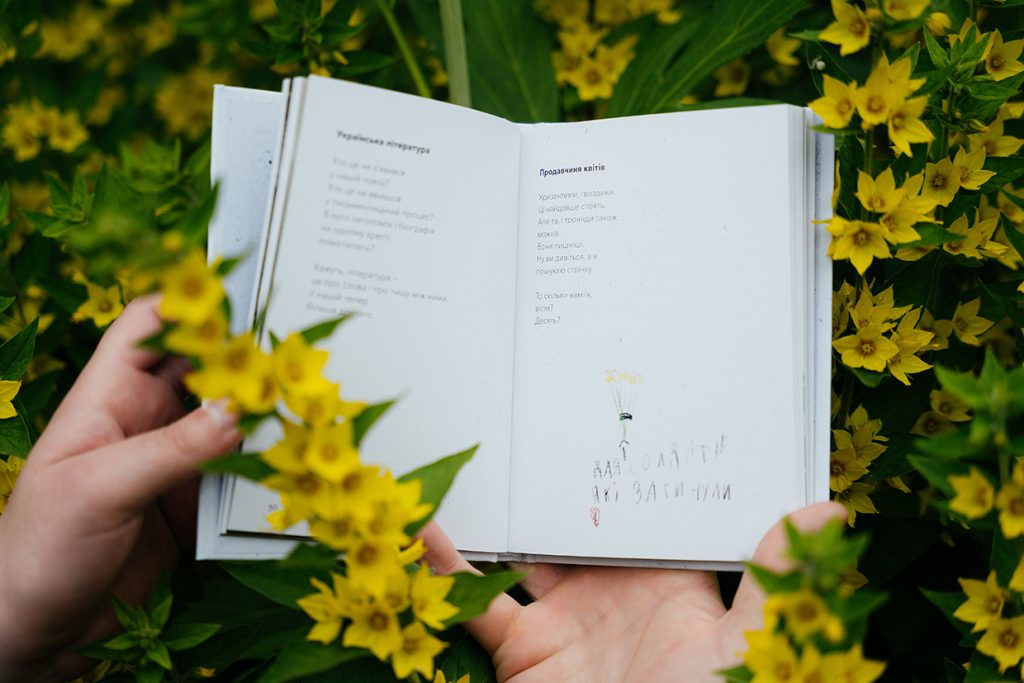
‘We were here’, Artur Dron, 2024. Photo by Halyna Zvarych
Olena Pshenychna: You talk a lot about the importance of memory. In your texts, you unpack this memory in detail, literally calling people by their names, above all, the names of your brothers-in-arms. Why is this so important to you? What does it mean to you to enshrine the memory of people and events?
Artur Dron: One of my greatest fears is the fear of forgetting. I remember when I first got scared of it at the beginning of 2023, after some time on the front line and after my first concussions. When we went out on those first combat missions, encountering something terrifying and difficult for the first time, it seemed to me that I would definitely never forget such things in my life. But in the spring of 2023, I started catching myself recalling certain things from that autumn of 2022 with difficulty, and it nearly sent me into a panic. Later in the book, I would use the phrasing: to remember all this is terrible, but worse still is to forget. Back then, in 2023, by the way, I started keeping a diary to write everything down, to enshrine it. This was my battle against that fear.
It seems to me that remembering and enshrining is one way to win, one way to compensate for something. Yes, writing won’t bring anyone back to you, of course, but there is something about simply sitting down and writing about that person. This is what literature is to me – telling a story about someone. And this is something I am grateful for to God, the world, and the circumstances, particularly for being able to use this skill to tell someone’s story. Because I have seen many who will not tell their own story. From the banal and the tragic – they won’t tell it because they are no longer here – to the more complex: they won’t tell it because they don’t know how to articulate it, won’t tell it because they don’t think it’s important, won’t tell it because they are afraid.
For me, literature, and poetry, in particular, is about taking something intimate and personal to you and making a text out of it, thereby converting it into something universal – something anyone can read. While reading this universal thing, the reader searches out something deeply personal for themselves, as if converting it once over again.
I have a story, which was also in We Were Here, about a photograph in a cemetery that had fallen. I picked it up and wrote a poem about it.
Before the book launch, I was told that the widow of this fallen soldier would be there. I hadn’t known him in life – only indirectly, knowing he was from my battalion. That was why I had gone to pray for him at the Field of Mars and picked up that photograph of his, finding a note there: ‘Happy anniversary, bunny, I love you.’ I realized that the woman coming to the presentation was the very person who had written that note, and I didn’t know what to do with that knowledge. I decided that, at the very least, I definitely wouldn’t read that poem, because it felt like it would be cruel, that it would cause her pain. Then time passed, I returned to duty, and this woman wrote to me. She sent a photo of the book, opened to that poem, with her husband’s grave in the background, and wrote: ‘I don’t know if that poem was about my note, but now it is about my note.’ And it completely threw me – it was like another lesson that those negative numbers exist, that there is plus and minus infinity.
Or there was another story. In the poem ‘First Corinthians’, there is a line: ‘love is wrapped in sleeping bags and carried out’. This was our first, shall we say, tragic experience evacuating the fallen. There was no way to carry them out on stretchers, so we wrapped the bodies of our brothers-in-arms in sleeping bags. And that’s exactly how I wrote it in the poem. Later, a woman wrote to me; we didn’t know each other. She just messaged me on Facebook, saying who she was, that she had read the poem, knew I served in the same battalion as her husband, and wanted to gift me her book about him. She said that this poem was incredibly important to her, because when she reads about the sleeping bags, she feels as though she is somehow learning more about how her husband died, how he was evacuated – as if it were about him. I didn’t reply to her for a week; I consulted with the guys about what to do, because, in fact, it was his body we had carried out back then. I hadn’t known him in life; he didn’t serve in my company but in another unit. During those days, he was at our positions and was indeed one of the first to fall. In fact, he was the first one we pulled out of the trench and carried away. In the end, I wrote back and told her about it, and she sent me the book about this guy. His callsign was Orel; her book was called The Island of Orel. It’s such a strong book, so powerful. And that is yet another manifestation of how literature works – working in a way that I still don’t fully understand.
Olena Pshenychna: You once said that ‘perhaps poems are what one person should have said to another but couldn’t’. Then what of prose?
Artur Dron: In my mind, prose is a slightly longer conversation that covers a wider range of topics than poetry. After all, a poem is a maximally concentrated, emotional and concise form in which you address a single, deeply important theme. It’s different with prose. It is a calmer, less emotional and longer conversation in which you can raise a larger number of topics and speak about various things. For me, it has always worked this way: there is something I want to write about and then I determine the best way to express it – be it a rhymed poem or an unrhymed one. But over time, I caught myself thinking that certain things could be best expressed precisely through prose.
Olena Pshenychna: The collection We Were Here was born on the front line. How was your book of prose born? And does its language differ from the language of your previous texts?
Artur Dron: Immediately after I sent the manuscript of the poetry book to the publishing house in the summer of 2023, literally the next day, I decided that my next book would be a collection of prose called Hemingway Knows Nothing.
We are used to the fact that there has always been great war literature, and its most prominent writers are Remarque and Hemingway. I personally used to think so. But when we experienced our own full-scale war, the perception of war literature was so completely overturned, and the texts of these guys were called into question.
When we faced our own real war of survival, these writers became irrelevant.
Hemingway was personally important to me throughout my youth. I loved him very much. Even at the beginning of 2022, I still believed him. And when I found myself on the front line, there was still a bit of that Hemingway left; I would tell the guys about some of his books. He was never a factor in my decision to go to war, but he was my favourite writer. However, he did not survive the Russo-Ukrainian war. When I lived through it, when I took part in it, I realized that Hemingway, after all, had never encountered anything like this. His first war was across the ocean from him; essentially, it threatened neither his parents nor his relatives. But in the context of guys like me, who went to serve at a young age – we didn’t go because we wanted to play the hero, which is exactly what Hemingway did. He wanted to play the hero, to absorb that feeling, and then he spent his whole life writing about it; he seemingly condemned war, yet constantly sought it out, somehow romanticizing it. I write exactly that in the book: he went to someone else’s war because he wanted to, while we went to our own because we had no other choice, because this war threatened us specifically, and we had to grow up very quickly and realize that we were already capable of protecting our fathers and mothers. This is something Hemingway never encountered; he didn’t know a single thing about it.
And I thought a lot about all these things; I wanted to write about a war that neither Hemingway nor Remarque, nor Vonnegut, nor Jünger, nor anyone else had seen except us. At first, I wrote two or three pieces, no more. By then, I was so sick to death of the army that I was utterly exhausted, dragging myself through that military routine with my last ounce of strength. I decided that writing about such a topic was a kind of self-flagellation and that it would be insincere – so I stopped writing. Then, in the spring of last year, I came back for medical treatment, had my heart treated, took medical leave, improved my health, cleared my head a bit, rebooted as much as I could, and then, in the spring, I wrote two more pieces for Radio Culture. Since then, I worked on the book bit by bit during periods of leave, in the Kharkiv region, and in the Zaporizhzhia region. But the bulk of the work after I was wounded, while undergoing treatment in the winter. Actually, it was then that I set a goal for myself – to finish the book by spring.
I used to be sceptical of all this talk about writing being psychotherapy and so on, but over time I became convinced that it really is the case. I really wanted this book to become a psychotherapy session of sorts.
I even show there how one such method works: prolonged exposure therapy. It is often used in treating PTSD, particularly with soldiers returning from war. This is when you recount the same traumatic story many times. You place yourself before that experience over and over again, trying to recreate and recall it in every detail. And each time, your story will be different; other details will emerge, and you remember what you had forgotten or, perhaps, had been hiding from yourself. It is a very difficult but interesting emotional process, because you can find the answers to some of your questions in the way the stories differ, and thus, over time, free yourself from it. With this book, I really wanted to show how it is done. To show that you can place yourself before fear, before trauma, before pain, call it by its name, look it in the eyes, try not to be afraid, and speak, speak, speak, in order to finally become free. I recount a lot of painful and personal things in it. This book is a soldier’s testimony about the experience of a major war. That is exactly how I define it – a book of testimonies.
As for the language of this prose compared to poetry – it’s actually a bit difficult to analyse the difference, because it’s the first time I’ve written in this genre. But I can analyse what they have in common. It seems to me that I still try to maintain this level of openness and sincerity. I still keep the language focused on others, with names and details. In poetry, details are very important, and here too they remain vital to me.
Olena Pshenychna: Finally, I want to quote your poem, which ends with a question: ‘I think about that box you mentioned. How did you pack those things? How do you live with all that?’ Do you have your own answer to the question of how we are all to live with this experience and rediscover faith, hope and love within it?
Artur Dron: I don’t have a ready answer. But when there is no ready answer, you have to consider which path holds more love – what love itself would point to in any given situation. Surely, it would point to the fact that we must not tear each other apart. We all have very different experiences. Yes, it is caused by one thing – war – but it is still very different. Sometimes it is so different even within a single family. And the most important thing is not to fall into excessive aggression but to seek mutual understanding and try to talk things through.
What else would love definitely point to? A sense of responsibility. It may sound complicated, but that is exactly how mature love acts in difficult circumstances. Everyone needs to take responsibility for some small part of what is happening. Sometimes love is not about romantic, light things. Sometimes it is about the responsibility to protect those you love.
This article is a redacted English translation of an interview originally published by The Ukrainians on 9 July 2025, which has been updated for accuracy where necessary.