

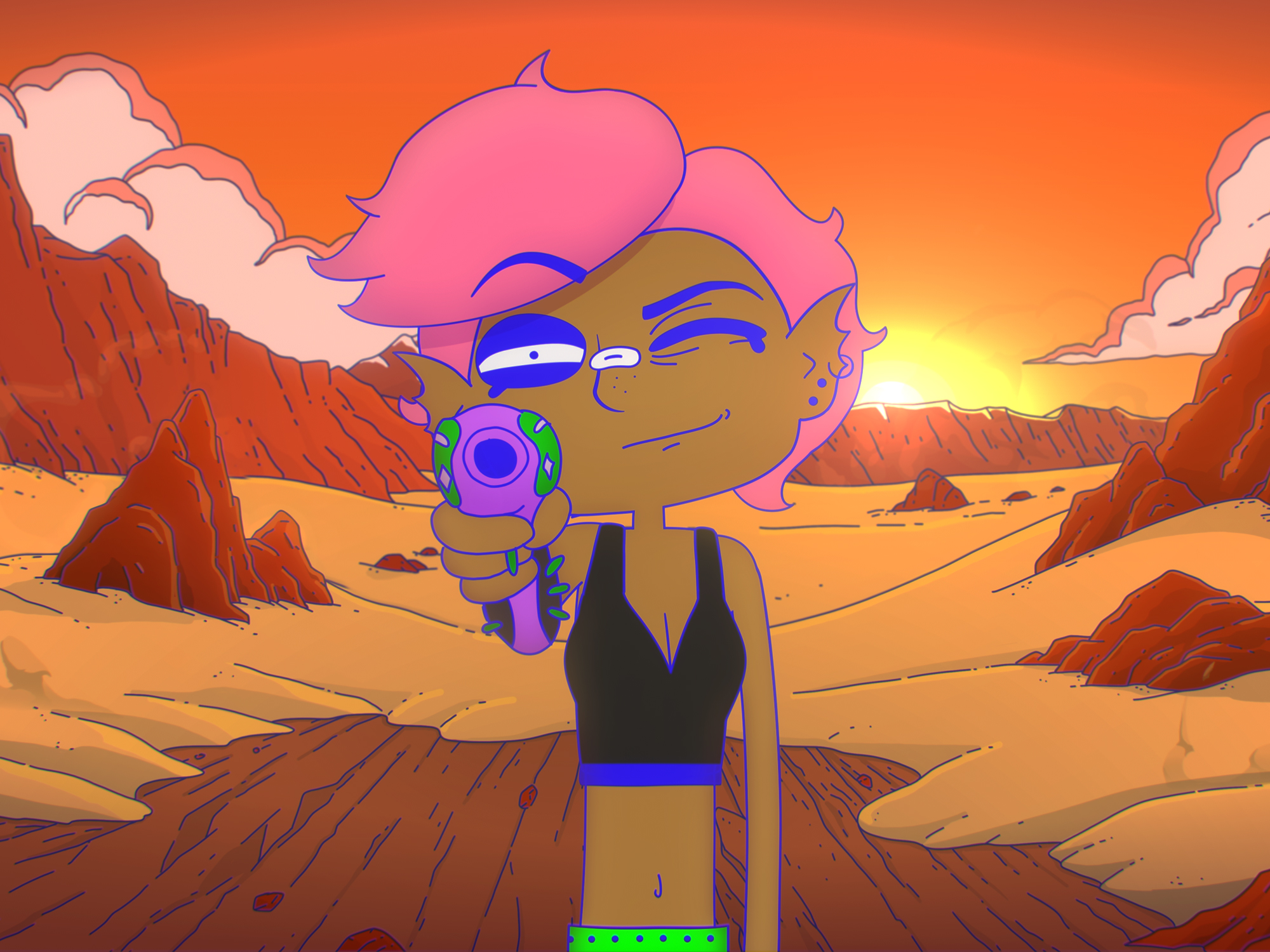
“I thought dating a space princess would be more… fun,” confesses Kiki (Bernie Van Tiel), the soon-to-be ex-girlfriend of Princess Saira (Shabana Azeez) of the planet Clitopolis. It’s the final straw for Saira, after being voted “the most boring royal” in gay space and repeatedly failing to fulfil her lesbian birthright of summoning a magical labrys. This introverted 23-year-old is the heart of Lesbian Space Princess, a bright 2D animation that traverses the new frontier of queer storytelling by locating conflict beyond coming-out plot points and heteronormative architecture. Though this departure from turmoil tied to queerness is as radical as the film ever gets.
When Saira’s self-assured bounty-hunter ex is kidnapped by extraterrestrial incels, the Straight White Maliens (Mark Samuel Bonanno, Broden Kelly and Zachary Ruane), the princess embarks on an inter-gay-lactic journey to rescue Kiki and, along the way, overcome her self-esteem issues. On this sci-fi expedition, Saira comes across a whole heap of characters, voiced by famous queer Australian performers, including Drag Race Down Under fan favourite Kween Kong as a ferocious drag queen named Blade and Gemma Chua-Tran as Willow, a manic-pixie, non-binary songwriter who offers Saira a new lease of life.
Get more Little White Lies
This mature, Sapphic sci-fi romp is the feature debut of the Australian writer-directors Leela Varghese and Emma Hough Hobbs. The two filmmakers make some bold swings in this bubbly and satirical animation that is as campy as it is colourful, populated by gangly-limbed characters reminiscent of Cartoon Network’s Adventure Time and paying homage to Sailor Moon and Revolutionary Girl Utena with a young protagonist seeking a magical artefact. The film finds particularly distinct originality in scenes of Saira’s mental interiority; dark visions of childhood trauma, rejection and damaged self-worth come to life with intriguing animation of shapeshifting, inky matter. This visualisation of Saira’s inner critic also allows Azeez’s voice acting to shift gears, articulating the depths of Saira’s demons.
While Lesbian Space Princess shoots for cheeky political commentary and “inside” jokes, there are several occasions where the satire falls into cringeworthy territory. Heavy-handed jokes about the dynamics of lesbian intercourse and Blue is the Warmest Colour’s sex scenes leave a bad taste and the phallic symbolism aligned with the Straight White Maliens, contrasting with the relentless vagina imagery circling the titular space princess, is offbeat at best and trans-exclusionary at worst. The lack of nuance when it comes to attempting subversive humour is a shame, as elsewhere Lesbian Space Princess offers self-aware, effervescent amusement.
Despite some missteps, directors Varghese and Hough Hobbs clearly have put a lot of love into this project, an independent animation that showcases the brightness of queer joy in the darkness. The film is by no means pure uncharted territory, nor does it perfectly stick the landing it sets up, but Lesbian Space Princess does bring a kaleidoscopic pink and purple-hued vision of Sapphic self-love.