

For this is why not only lice, bedbugs, fleas and helminths, come into being as the guests and neighbours of our wretchedness, and are born from our inmost parts and our excrement, but also, if a soiled shirt is placed in the opening of a vessel containing grains of wheat, then within a few days the leaven, which has been absorbed from the cloth and transformed by the scent of the wheat, turns the wheat itself – covered in its own husk – into mice.
Above is an excerpt from Ortus Medicinae, a work written in the first half of the seventeenth century by alchemist and physician Jan Baptist van Helmont (1580–1644). In this so-called ‘recipe for mice’ he put forth one of many arguments in favour of vitalism – the theory that living organisms can arise spontaneously out of non-living matter. Proponents of vitalism believed that life was purposefully organized and that it could not be understood merely as a result of mechanical processes. Rather, life was governed by a certain innate vital force, vis vitalis, that distinguished the living from the dead.
By the mid-nineteenth century it was already long established that neither lice nor mice could arise spontaneously; they must have parents. But microscopes had opened up a previously invisible world of microscopic organisms, and in studies of nutrient liquids like meat broth or hay extract it seemed as though such living creatures could actually arise spontaneously – even when the nutrient liquids had been sterilized through careful heating.
French scientist and physician Félix-Archimède Pouchet (1800–1872) was one of the foremost proponents of vitalism. In 1859 he published Hétérogénie, a work in which he claimed to present indisputable experimental proof that microorganisms could arise spontaneously in sterilized nutrient liquids. His reasoning suggested the presence of a God-given force that organizes all living things, a force that attracts and arranges lifeless matter and that continuously acts in opposition to processes of decay. However, the book’s conclusions contradicted a different, growing school of thought which asserted that all life, including microscopic life, must have parents, and that such parents had reached the sterilized nutrient liquids of Pouchet’s experiments via airborne particles and dust.
To resolve the question of spontaneous generation, and settle the fierce debates surrounding it both within and outside of scientific circles, the French Academy of Science organized a competition in 1859 which offered a gold medal to the value of 2,500 franc (equivalent to almost one hundred thousand euro today) to a scientist who ‘through rigorously conducted experiments shed new light on the issue of so-called spontaneous generation.’ The question of life’s origin was to be resolved, and a winner to be selected by a commission of prominent and reputable scientists from a range of related disciplines.
That same year, seemingly indifferent to the commotion in France, Charles Darwin published his groundbreaking work On the Origin of Species in which he deliberately avoided the question of life’s origin. He directed his attention instead towards that which binds all living things throughout the history of life together – evolution – which he refers to as ‘that mystery of mysteries’ in the book’s foreword. To Darwin, the existence of life was a sufficient starting point, and the question of life’s origin lay beyond the scope of what contemporary scientists ought to speculate on. As he put it in a letter to a friend in the British Royal Society a few years after the publication of his masterpiece: ‘It is mere rubbish thinking, at present, of origin of life; one might as well think of origin of matter.’
One of the scientists who did throw his hat into the ring was French chemist and apothecary Louis Pasteur (1822–1895), whose experiments have become textbook examples on how scientific hypotheses should be proven through carefully planned experiments, repetition and verification. In one of his most decisive experiments, nutritious meat broth was heated to the point of sterilization inside a flask with a curved neck that tapered into a narrow opening. The flask, known as a swan-neck flask, was sealed upon sterilization and later opened to expose its contents to the surrounding air. Save for the use of swan-neck flasks, Pouchet had conducted very similar experiments and claimed to have found that microorganisms can grow in sterilized nutrient liquid no matter what kind of air it is exposed to: polluted Paris street air, air collected during a costly expedition to the Maladetta glacier at an altitude of 3,300 meters – where the air was considered exceptionally pure and free of microscopic life – and even artificial air enriched with oxygen, a component that Pouchet and his colleagues considered one of the necessary conditions for spontaneous generation.
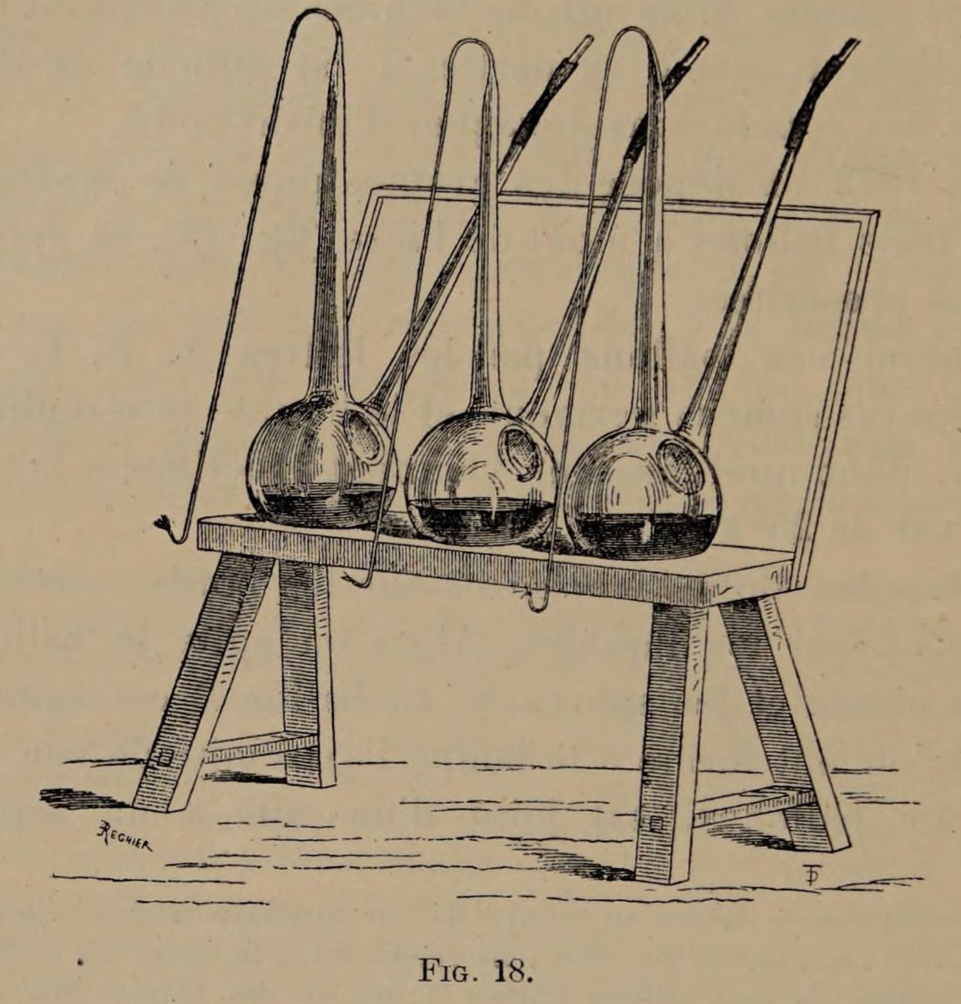
Illustration of swan-neck flasks used by Pasteur. Image via L. Pasteur, Oeuvres de Pasteur 1822–1895, internet archive
To expose the sterilized broth to the oxygen-rich air that Pouchet claimed was necessary for life to arise, Pasteur opened the narrow mouth of his swan-neck flask, and although the broth now came in contact with the air’s oxygen, most samples remained completely clear and free of microscopic life. The cleaner the air (if the flasks were opened at high altitudes, for example), the fewer of the broth samples were clouded with microscopic life. When the flask neck was instead broken off closer to the base, so that the air made direct contact with the liquid without passing through the long, thin neck, the broth quickly became clouded. The same thing happened when an intact flask was shaken so that its liquid came in contact with the inner surface of the neck. The results indicated that airborne microscopic particles were the carriers of life. They stuck to the inner surface of the flask neck while oxygen-rich air passed through, which was precisely the hypothesis Pasteur had assumed, and the very reason behind the flask’s clever design.
Nevertheless, Pouchet defended his conclusions and claimed that Pasteur’s prolonged heating process had destroyed the broth’s vital force. Yet when the French Academy of Science’s commission responded to the criticism by requesting the experiments be repeated, Pouchet declined, upon which the commission validated the exactness of Pasteur’s experiments and unanimously declared him victorious. The debate continued for some time, motivated in part by the occasional presence of living organisms in Pasteur’s experiments. It wasn’t until many years later, when Pasteur had demonstrated that Pouchet’s equipment had been contaminated by microscopic organisms during the experiments, and scientists had discovered in certain nutritious liquids the presence of spores – a resistant, dormant stage in certain microorganisms that allow them to survive boiling – that the battle could be settled once and for all.
Even Darwin commented on the origin of life at that time, which was a rare occurrence. He wrote in a letter dated 1871: ‘But if (& oh what a big if) we could conceive in some warm little pond … a protein compound was chemically formed, ready to undergo still more complex changes.’ To this day, Darwin’s hypothesis about a primordial non-living environment in which the first seed of life once came into existence remains influential among the many researchers who attempt to answer the question of life’s origin. Yet now when they speak about this ‘pond’ they refer to something close to four billion years old. In addition, the protein compound Darwin speaks of has in several models been replaced by self-replicating RNA-molecules, which are believed to have started the chemical process that remains ongoing in all known living things. Despite all progress made in the name of science, no one has yet conducted an experiment in which life arises spontaneously out of non-living matter. Yet at some point, somewhere, life came into existence. The question of how it did still remains.