

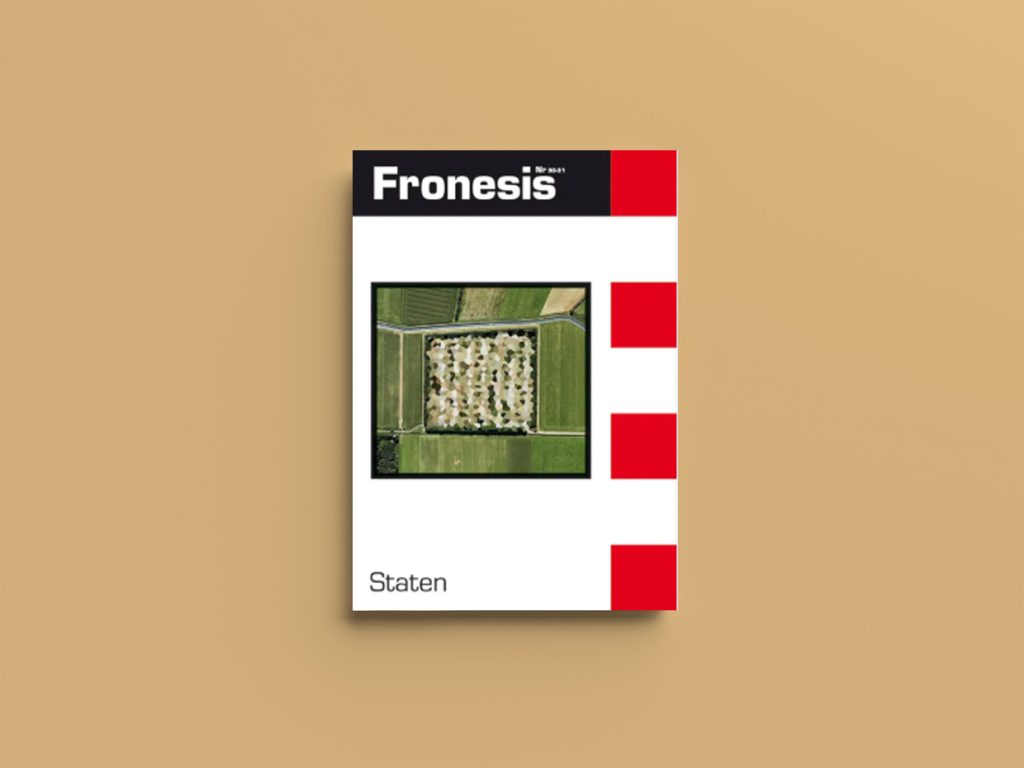
The state is back – or perhaps it never left. The 2008 financial crisis ‘decisively called into question the thesis that the state is being sidelined by the market’, write the editors of Fronesis (Sweden). Subsequent crises – from the pandemic to geopolitical conflict and industrial policy – have only quickened its return.
Yet this issue of Fronesis is more concerned with what kind of state is emerging. As the editors observe, ‘the political debate today seems increasingly less concerned with the choice between public and private solutions; instead, the fault lines appear to run through the state itself’.
The issue’s contrasting epigraphs encapsulate this tension. Hannah Arendt presents authority as a form of obedience compatible with freedom, while Friedrich Nietzsche traces the state’s origins to domination and conquest.
Rather than resolving this opposition, contributors explore it from multiple angles. The issue moves from questions of legibility, population management and reproductive governance to broader debates about capitalism, neoliberalism and state power. Throughout, the state emerges ‘not as a solution in itself, but as a concentration of the contradictions and possibilities of the present’.
Rupture
During the global financial crisis of 2008 and its aftermath, many states intervened to stabilize financial systems, stimulate demand and secure corporate financing. Vanja Carlsson asks whether this resurgence of state intervention marks the beginning of the end for neoliberalism – or merely its latest mutation.
To answer this question, Carlsson compares two schools of thought. The first argues that neoliberalism remains very much alive, adapting to shifting political and economic realities. The state may be back, but it continues to serve neoliberal objectives centred on competitiveness and profitability.
Regulation theory offers a different diagnosis. According to this view, neoliberalism has entered a structural crisis. Rather than adapting to new conditions, the neoliberal mode of regulation may be giving way to something fundamentally different. This is not a mutation, but a genuine historical rupture.
Carlsson questions what would count as proof that state capitalism has indeed supplanted neoliberalism, when we have no clear definition of the latter. This ultimately opens onto a broader conceptual problem: ‘The question is not only how state interventions should be classified, but also how we are to determine when a historical form of capitalism is in crisis, being transformed, or being replaced by something new.’
Counted
Sweden, which has the world’s oldest population registration system, serves as the paradigmatic case in Andreas Asplén Lundstedt’s article on the history of censuses and population registration.
Viewed as technologies of governance that enable welfare and exclusion, recognition and control, these systems reveal the deeply political nature of counting people. From the earliest known census, dating back to around 3800 BCE in the Sumerian Empire, ‘the counting of people has been intimately linked to the centralization of power’.
Lundstedt devotes particular attention to the advent of the personal identity number in Sweden – and the tensions it gave rise to. Seen in some countries as overly intrusive, such unique identifiers accompany individuals ‘from cradle to grave’ and make it possible to integrate information from multiple administrative registers.
In an age of facial recognition technology and the expansion of digital surveillance, the Swedish case raises a broader question: how much privacy should be sacrificed on the altar of administrative legibility and efficiency?
Census-taking does not merely document reality; it helps shape it. ‘Legibility is not simply a capacity to describe the population; it also expands the horizons of bureaucratic and political imagination.’ The 1747 estimate of Sweden’s population is a case in point: the figure shocked policymakers by coming in far below expectations and directly contributed to the creation of new administrative institutions and demographic interventions.
Childbearing
As birth rates decline, many states have fallen back into an old pattern in which childbearing is viewed less as a personal choice than as a collective responsibility, even a duty. The language of ‘demographic balance’, ‘dependency ratios’ and ‘the future labour force’ increasingly frames reproduction as a solution to social and economic problems, rather than as a deeply private decision.
Evelina Johansson Wilén examines how parenthood is being re-politicized from all sides. While natalists present childbearing as a social necessity, anti-natalists increasingly frame non-childbearing as an ethical imperative. Both risk reducing reproduction to an instrument for achieving broader political goals. Parenthood, Johansson Wilén argues, remains an ‘existential leap’: an irreversible commitment to an uncertain future that cannot be justified solely through demographic, economic or ecological reasoning.
That leap has become all the more daunting when families are increasingly expected to shoulder responsibilities once supported by collective welfare institutions. At the same time, fears associated with the so-called Great Replacement Theory give a boost to policies that restrict reproductive rights for some groups while encouraging reproduction among others in the name of preserving a ‘white demographic majority’.
Anarchism
Along his winding intellectual journey, from his early studies of peasant societies in Southeast Asia to seminal works such as Weapons of the Weak and Seeing Like a State, James C. Scott developed a singular anarchist perspective on statecraft. His attention to the ‘small arms of class struggle’ – rumour, foot-dragging, desertion, petty theft and sabotage – reveals the everyday resistance concealed beneath apparent compliance, writes Mikael Omstedt.
This ‘anarchist squint’, as Scott called it, usefully ‘denaturalizes our state-centred present’. But the lens ultimately reproduces a liberal opposition between state and society, Omstedt argues, abandoning the state as a terrain of struggle and consistently projecting social antagonisms and emancipatory aspirations onto ‘an untainted realm beyond the state’.