

Conny Waters – AncientPages.com – New research reveals that a major prehistoric center in Ireland was among the earliest large, organized settlements in Western Europe, dating back over 3,000 years. Around 1200 BC, the construction of the monumental Haughey’s Fort established a significant prehistoric center, preceding Navan Fort’s role as the mythological capital of Ulster.
The study identifies Haughey’s Fort, near Armagh in Northern Ireland, as the center of a large, planned landscape in which settlement, craft production, and ritual converged on an unprecedented scale from around 1200 BC.
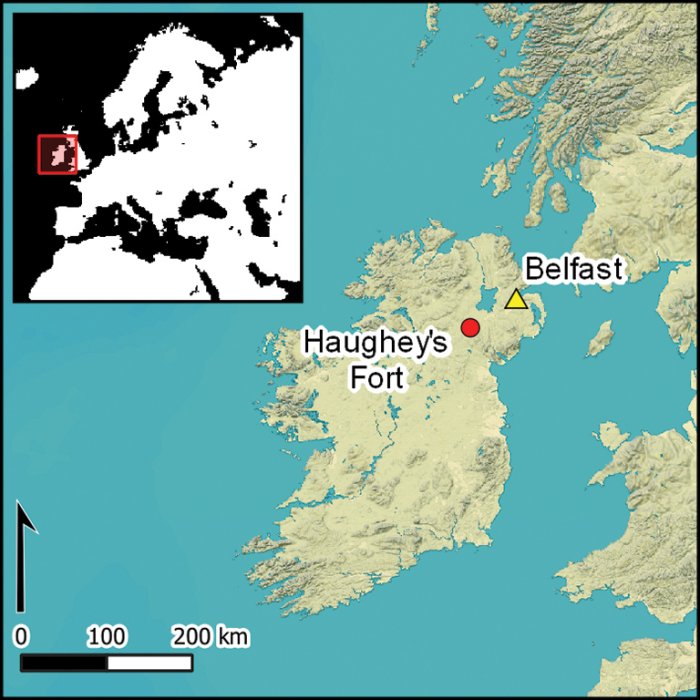
Credit: J. O’Driscoll, P. Gleeson, Antiquity 2026
While the Navan prehistoric complex is best known as the Iron Age capital of Ulster with early medieval literary connections, research demonstrates that it was already a thriving, complex hub in the Late Bronze Age.
Led by Dr James O’Driscoll of the University of Glasgow and Dr Patrick Gleeson of Queen’s University Belfast, the research combines advanced remote sensing, geophysical surveys, targeted excavation, and archival analysis.
The study identifies evidence of over 200 possible wooden domestic structures at Haughey’s Fort, indicating a dense and organized settlement that far exceeds typical hillforts. Large circular buildings, some up to 30 meters in diameter, likely served as institutional or communal spaces, supporting the interpretation of the site as an “urban” center.
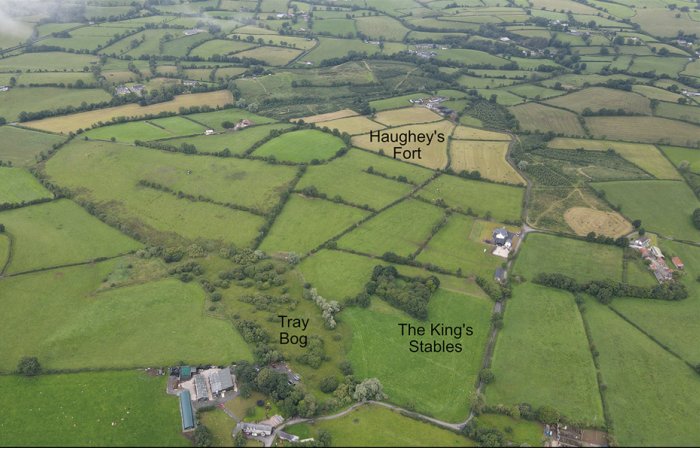
Credit: University of Glasgow
The paper also indicates that the landscape reflects a thriving and well-connected Bronze Age community. Evidence of specialist bronze and gold-working, large-scale feasting, and high-status artifacts highlights both economic activity and social organization. Imported objects suggest long-distance connections to regions as distant as the Iberian Peninsula and Central Europe.
Haughey’s Fort was part of a larger complex that included the King’s Stables, an artificial pool used for ritual deposition of weapon moulds, animal remains, and human bone fragments. A palisade-lined ceremonial avenue physically and symbolically linked the fort to the pool, likely for formal processions. The Creeveroe Earthworks, reinterpreted in this study as a vast 109-hectare outer enclosure, make the site one of the largest known archaeological monuments in Ireland or Britain.
“Our research demonstrates a level of scale, organization and connectivity in Bronze Age Ireland that has not been fully recognized until now. The evidence from Haughey’s Fort points to a large, densely occupied settlement where craft production, exchange and communal activity were all closely integrated,” Dr. O’Driscoll, Lecturer in Geospatial Archaeology at Glasgow’s School of Humanities, says.
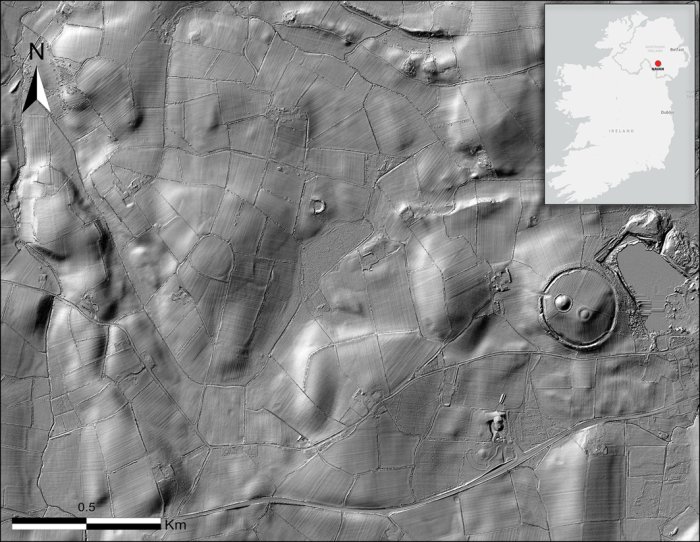
Location and lidar imaging of the Navan landscape, County Armagh, Northern Ireland. Credit: J. O’Driscoll, P. Gleeson, Antiquity 2026
“In a wider Western European context, this places Haughey’s Fort among the clearest examples of a proto-urban center, showing that large, organized settlements were beginning to take shape around 3,000 years ago. This fundamentally changes how we understand the site and highlights the extent to which communities in Ireland were connected to broader developments across Bronze Age Europe.”
“The study makes it clear that we are not looking at isolated monuments, but at a single, highly organized landscape. Our work shows that Haughey’s Fort, the King’s Stables, and the Creeveroe Earthworks were all part of an interconnected system, carefully structured to bring together settlement, production and ritual.
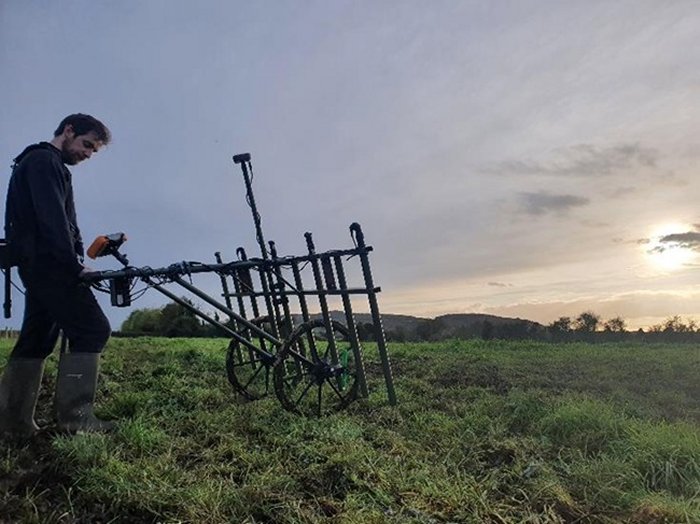
Dr Patrick Gleeson doing some gradiometry surveying. Credit: University of Glasgow
“This allows us to reinterpret the entire complex on a new scale. It represents one of the most extensive and coherent Late Bronze Age landscapes in Western Europe, and shows how communities actively organized movement, belief and authority across a monumental setting,” Dr Patrick Gleeson, Senior Lecturer in Early Medieval Archaeology at Queen’s School of the Natural and Built Environment, comments.
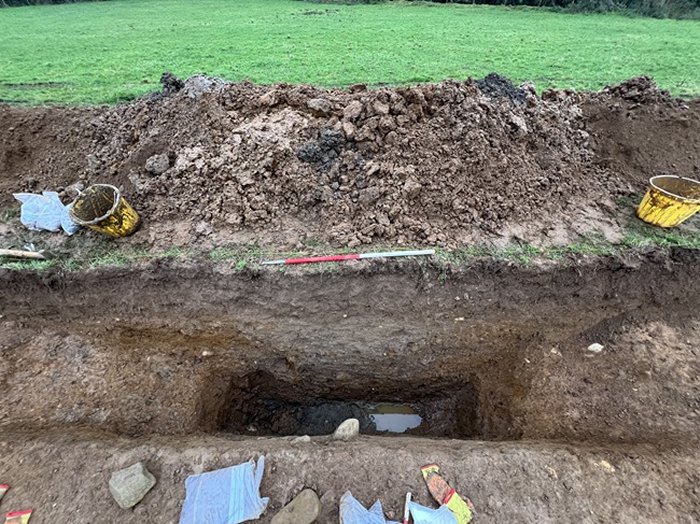
Excavation of the Creeveroe Enclosure (Inner ditch). Credit: University of Glasgow
The study demonstrates clear functional zoning across the landscape: production, feasting, and settlement were centered at Haughey’s Fort, while ritual deposition and ideological practices took place at the King’s Stables. These findings indicate a highly organized and engineered landscape.
Dr O’Driscoll and Dr Gleeson in their paper conclude: “Individually, Haughey’s Fort, the King’s Stables and The Creeveroe Earthworks are unique and important monuments. Collectively, they constitute an unparalleled interconnected monumental landscape that served as a regional hub of power, production, and ritual in the Late Bronze Age.
See also: More Archaeology News
The scale and uniqueness of this landscape offer valuable insight into the complexity and influence of Late Bronze Age communities, significantly contributing to our broader understanding of social organization, economic activity, and ritual practice within European prehistory.”
The study was published in the journal Antiquity
Written by Conny Waters – AncientPages.com Staff Writer