

Conny Waters – AncientPages.com – Board games were central to Roman society and enjoyed by all social classes, from enslaved individuals to the Emperor. Many, such as Duodecim Scripta and Ala, resemble games still played today and are likely ancestors of modern backgammon.
Other games, especially those involving dice, remain mysterious because their rules were not recorded. However, games of chance using dice or knucklebones, as well as board games, were widespread throughout the Roman Empire.
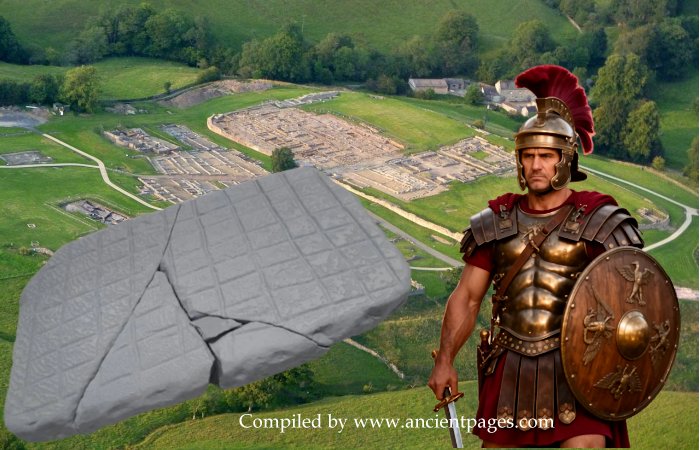
Background: Vindolanda seen from the air. Credit: Mike Bishop – CC BY-SA 2.0, Left: Ludus Latrunculorum – Credit: Newcastle University, Right: Artistic impression of a Roman Soldier – Credit: AncientPages.com
To reconstruct the rules of ancient board games, archaeologists combine evidence from ancient authors such as Ovid and Martial with material finds, including gaming boards, pieces, and dice.
Archaeologists have discovered gaming boards and related artifacts throughout Roman Britain, including in towns, villas, villages, roadside settlements, and military sites. Examining where these items are found helps identify who played board games.
What Is The Ludus Latrunculorum, The Roman Board Game Discovered At Vindolanda?
In 2019, archaeologists at Vindolanda discovered a Ludus Latrunculorum board, also known as ‘the game of little brigands or soldiers’. As the most popular board game in Roman Britain, it was found between a bathhouse drain and a workshop wall, near a late-third-century road.
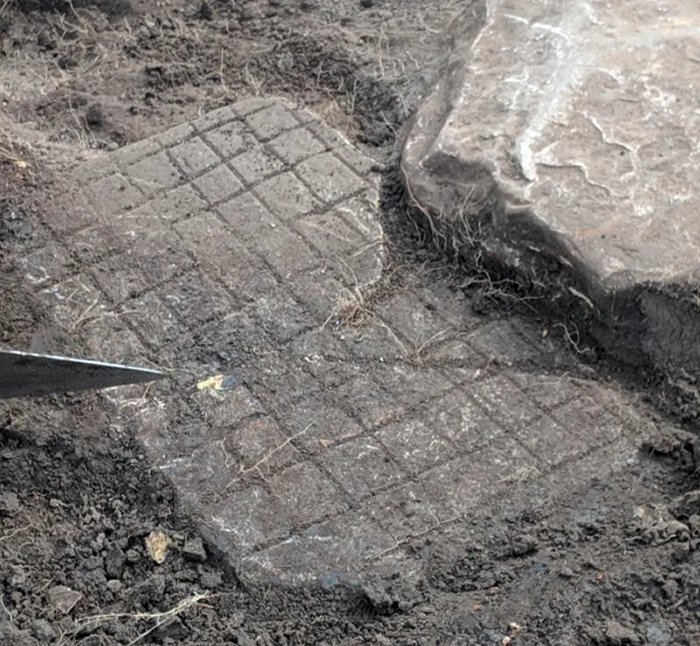
Original Roman game board artifact (excavated in 2019), found in the ground. Credit: Newcastle University
Vindolanda’s population ranged from 1,500 to 5,000 and was not exclusively military. Many women, children, traders, and slaves lived there. This diverse community imported goods from across the empire, including Arabian spices, Baltic amber, and Mediterranean olive oil and wine.
Finding the game outside the fort shows it was not limited to soldiers. Women, children, and civilians also played, making it accessible to the entire community.
In later years, the board was reused as flagstones for a farm built on the site, a common practice for Roman stone at the time.
Through a partnership between the Vindolanda Charitable Trust and Newcastle University, 3D printing now allows us to experience Roman Britain’s most popular game in new ways.
How To Play Ludus Latrunculorum
Although the exact rules of this historical game remain unknown, archaeological evidence suggests it was an ancient Roman two-player strategy game similar to modern draughts. Some possible rules have been inferred from these findings.
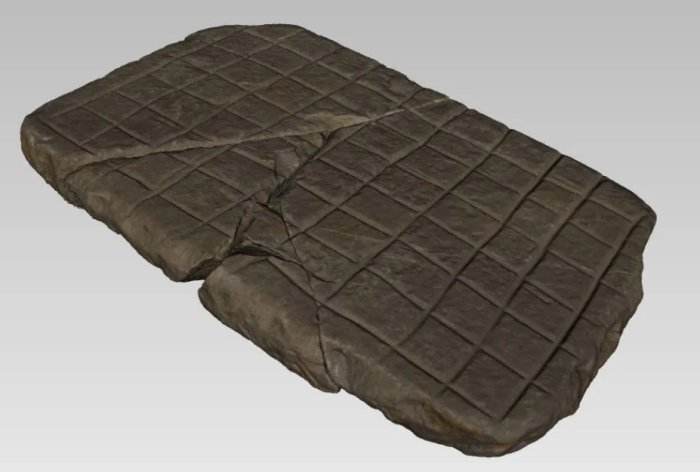
Credit: Newcastle University
The game can be played on any gridded board, but was traditionally played on square or rectangular boards with seven to twelve squares across.
Players use their “soldiers” to trap opposing pieces, aiming to immobilize their opponent or capture the special King piece.
Bringing History To Life With 3D Printing
The game is currently on display in Toronto’s Bata Shoe Museum as part of the exhibition ‘Unearthing Vindolanda: Footwear from the Edge of the Roman Empire’, which will run throughout 2026 and 2027.
Before sending the game to Canada, the Vindolanda team contacted Paul Watson, Electrical & Electronic Team Leader, and Dr Jenny Olsen, Lecturer in Mechanical Engineering, at Newcastle University.
They aimed to scan and 3D print a realistic replica of the Roman game board using the University’s advanced facilities.
Vindolanda staff Sophie Westlake (Activity and Diversity Officer) and Barbara Birley (Senior Curator) transported the board to the Stephenson Building.
The original Roman board comprised five separate stone pieces that fit together to form the complete game board. Each piece was individually scanned using the University’s handheld high-resolution 3D scanner, the Artec 3D Spider. The resulting dataset enabled the creation of a realistic 3D model, which was printed in biodegradable Polylactic Acid (PLA).
This project exemplifies effective cross-sector collaboration, enabling valuable skill-sharing between teams that would not typically interact.
The Newcastle team demonstrated the object-scanning setup and methodology to Vindolanda’s staff, enabling them to independently scan pieces of the Roman game board.
The process was a valuable learning experience for experts at Newcastle University’s School of Engineering. The team applied the 3D scanner to real-world challenges and later trained other university staff to use the equipment for related engineering projects. The realism and detail of the Roman board model highlight recent advancements in 3D scanning and printing technology.
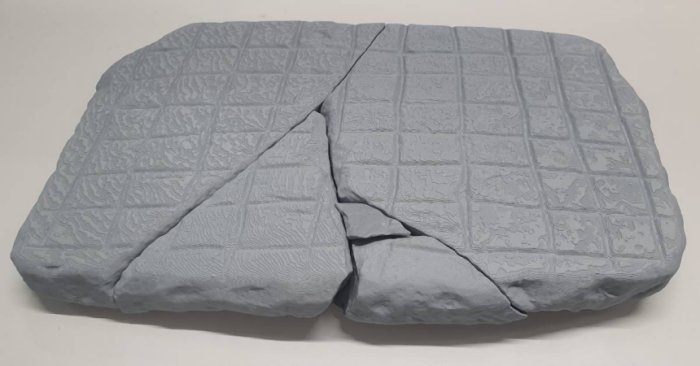
The original game was discovered in pieces, and this is reflected in the 3D-printed version.Credit: Newcastle University
After producing the 3D game replica, the team provided it to the Vindolanda Charitable Trust for use in a public engagement program at The Roman Army Museum. The model allows visitors to play the ancient game on a replica of the original board, offering an interactive experience beyond traditional displays.
“It was amazing to be involved in the actual scanning process and to see something so complex and historical be realistically recreated. It will be very beneficial for the Vindolanda Trust to have a replica Roman game board and 3D interactive model, both whilst the original Roman board is on loan and to create a more engaging, tactile experience for the visitor,” Sophie Westlake, Activity & Diversity Officer, said.
An interactive 3D computer model of the scanned Roman board was created from the original scans. This allows museum visitors to explore the model from all angles by zooming and rotating.
The collaboration between Vindolanda and Newcastle staff has led to ongoing discussions about joint student projects for undergraduate courses. These projects give students practical experience in applying engineering skills to real-world challenges and achieving meaningful results.
From Dice To Duty: Gaming And Daily Life At Vindolanda
The Vindolanda Roman Fort collection, ranging from children’s shoes to gaming boards, illustrates how military and family life overlapped in this frontier community. Vindolanda holds 16 gaming boards, about 15% of all found in Roman Britain, making it the largest such collection in the country.
See also: More Archaeology News
The material culture from Vindolanda represents one of the most significant and diverse single-site Roman collections in the Empire. These objects provide direct insight into life at the site from its foundation around 85 AD to its abandonment in the 9th century.
Discoveries from Vindolanda have greatly enhanced understanding of everyday life on the Roman frontier. The collection features items that reveal Roman knowledge of technology, architecture, language, government, town planning, and personal identity. Highlights include writing tablets, thousands of boots and shoes, jewelry, armor, weapons, and tools.
Source: Newcastle University
Written by Conny Waters – AncientPages.com Staff Writer