

Jan Bartek – AncientPages.com – One of the most intriguing questions in human evolution is why about 90% of people across all cultures favor their right hand, a population-level preference unmatched by any other primate species. Despite decades of research into the brains, genes, and development underlying handedness, the reason for this strong right-handedness in humans remains an evolutionary mystery.

Recent research led by the University of Oxford and published in PLOS Biology suggests the answer lies in two key aspects of human evolution: bipedalism and significant brain expansion.
Dr Thomas A. Püschel and Rachel M. Hurwitz at Oxford’s School of Anthropology and Museum Ethnography, along with Professor Chris Venditti at the University of Reading, analyzed data from 2,025 individuals across 41 monkey and ape species. Using Bayesian modeling that accounts for evolutionary relationships, the team tested major hypotheses about the evolution of handedness, including tool use, diet, habitat, body mass, social organization, brain size, and locomotion.
Humans did not fit the pattern that explained other primates. However, when researchers included brain size and the relative length of arms to legs, an anatomical marker of bipedalism, this exception disappeared. Accounting for upright walking and a large brain, humans no longer appear to be an evolutionary anomaly.
Applying the same models, the team estimated likely handedness in extinct human ancestors. The results suggest a gradient: early hominins like Ardipithecus and Australopithecus likely had only mild right-hand preferences, similar to modern great apes. With the emergence of the genus Homo, this bias increased significantly, reaching its current extreme in Homo sapiens.
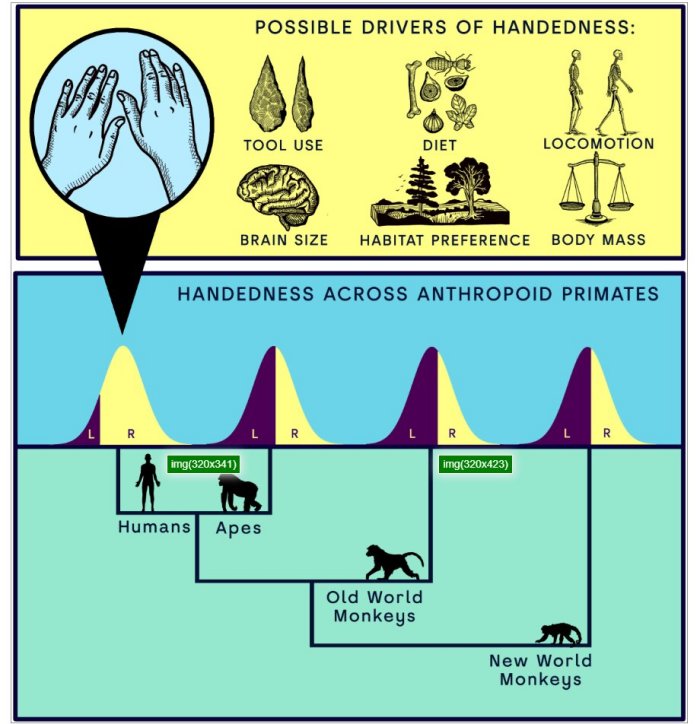
Drivers often proposed to explain the unique pattern of human handedness direction. Credit: PLOS Biology (2026). DOI: 10.1371/journal.pbio.3003771
One notable exception is Homo floresiensis, the small-brained “hobbit” species from Indonesia, which shows a much weaker predicted preference. Researchers suggest this aligns with the broader pattern, as floresiensis had a small brain and a body adapted for both upright walking and climbing, rather than full bipedalism.
The findings point to a two-step process. First, walking upright allowed hands to be used for tasks instead of movement, which led to pressure for more precise and specialized hand use. Later, as brains developed and changed, a right-hand preference became the common pattern we see today.
The study points out several topics for future research. These include how human culture affects right-handedness, why left-handedness persists, and whether animals such as parrots and kangaroos exhibit similar limb preferences, which could suggest a broader pattern across species.
The study was published in the journal PLOS Biology
Written by Jan Bartek – AncientPages.com Staff Writer